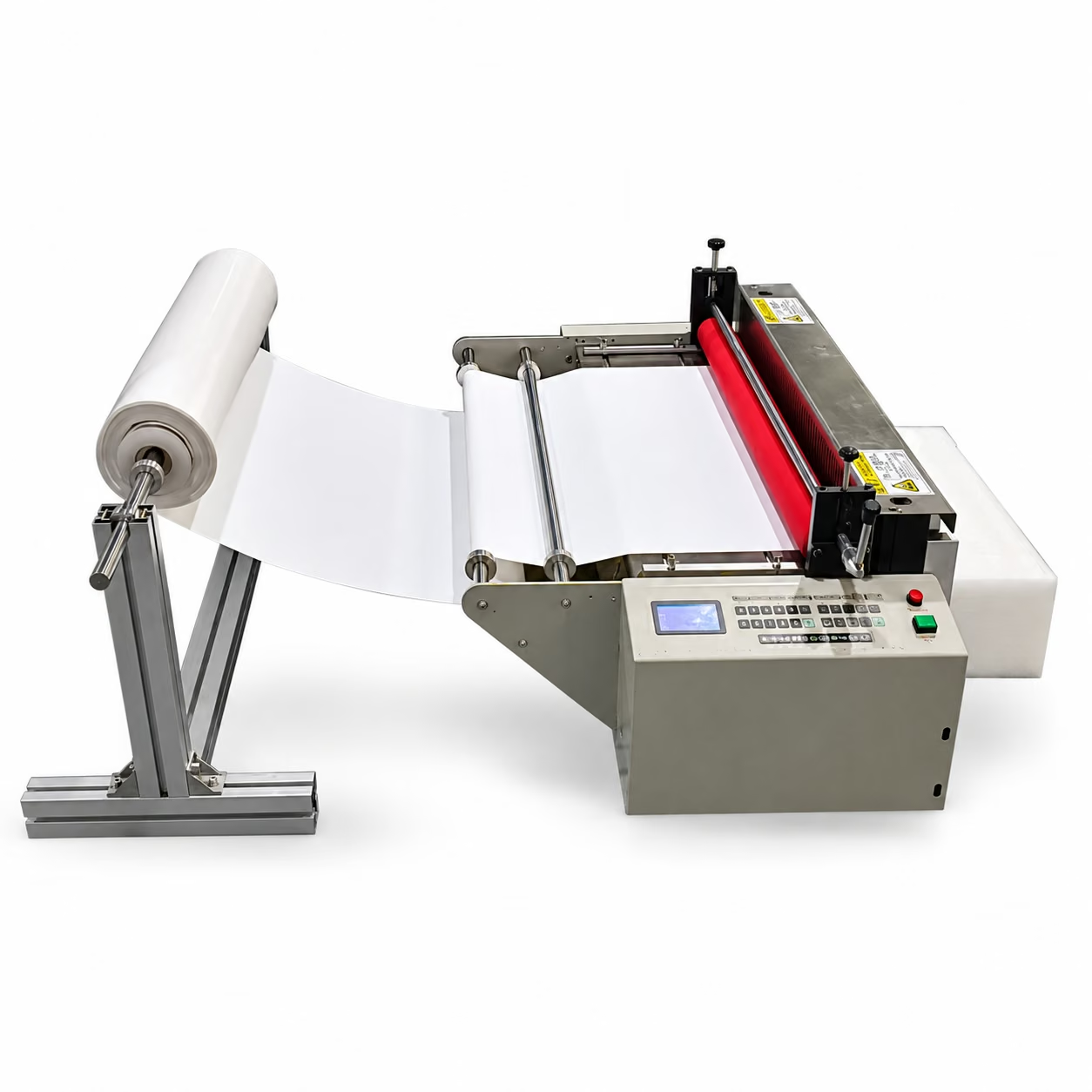
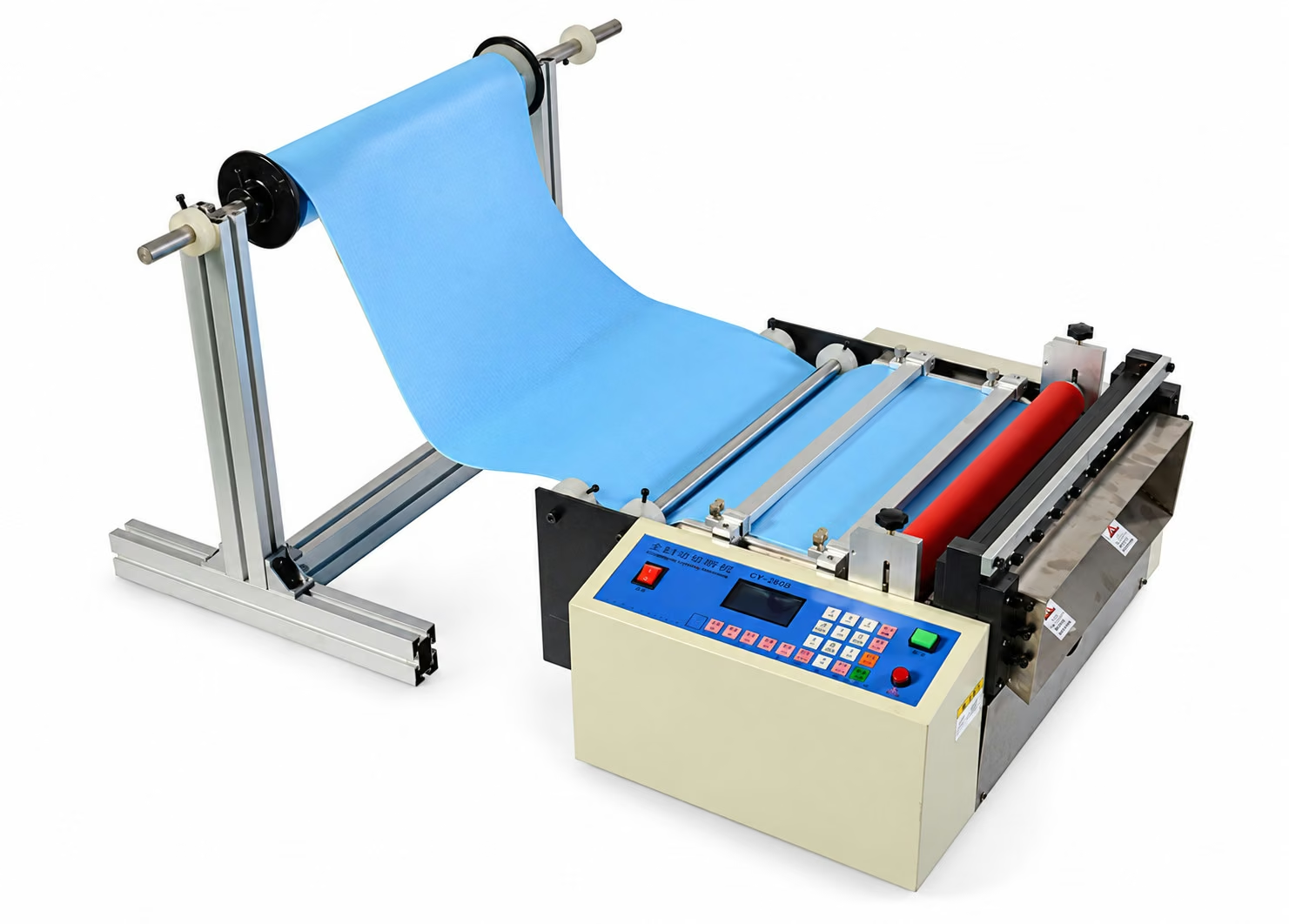
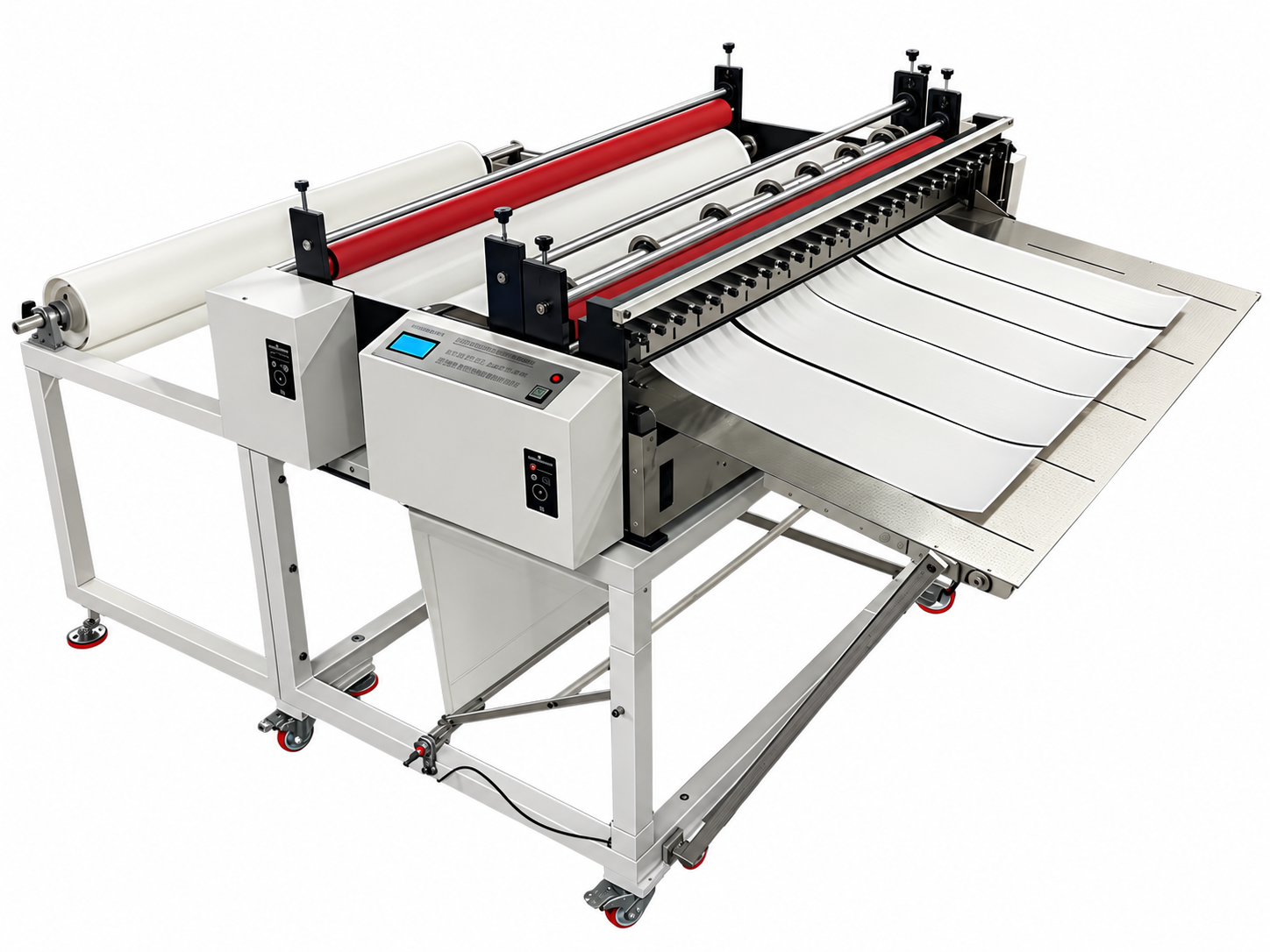
Automatic roll feeding
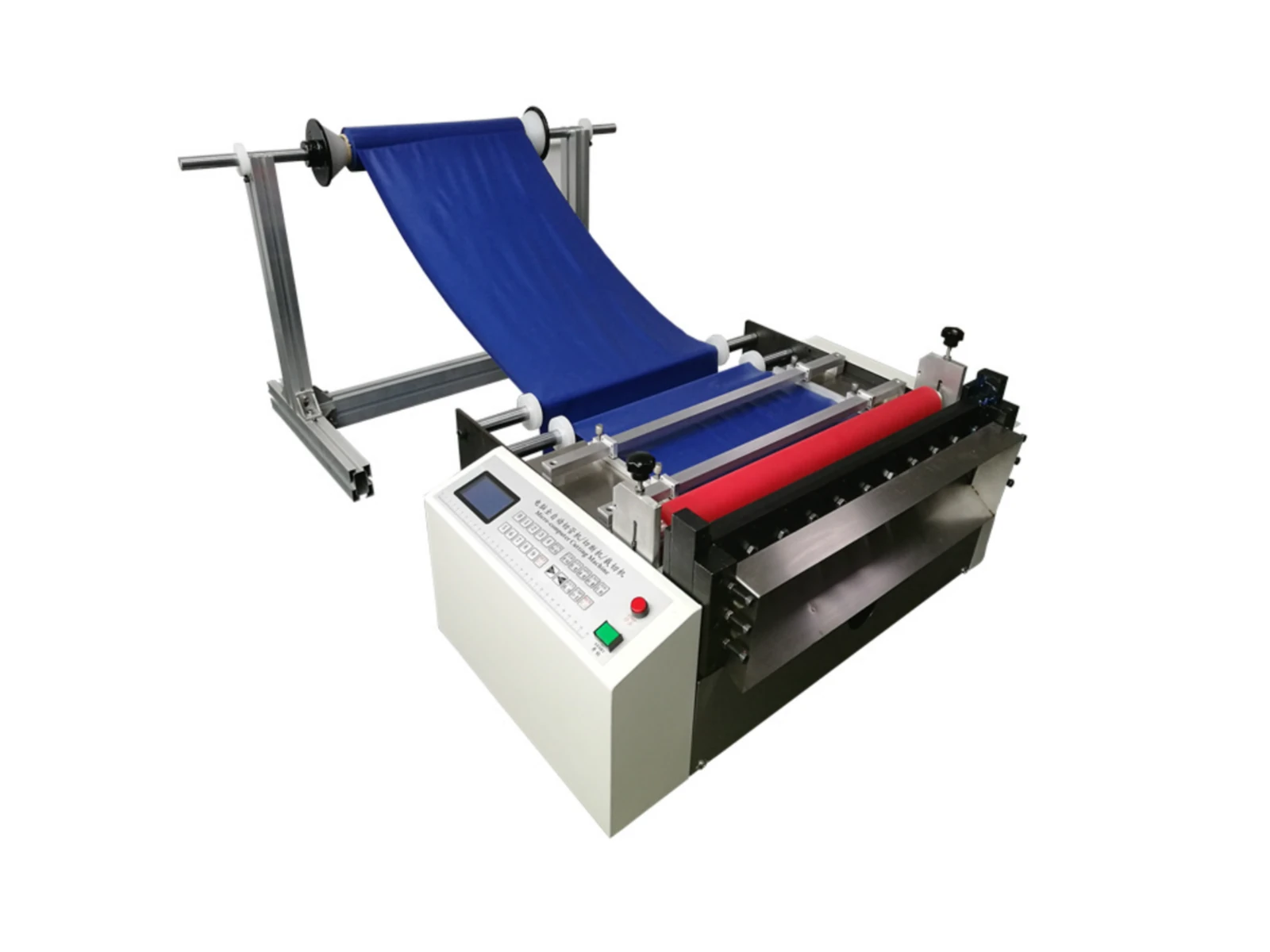
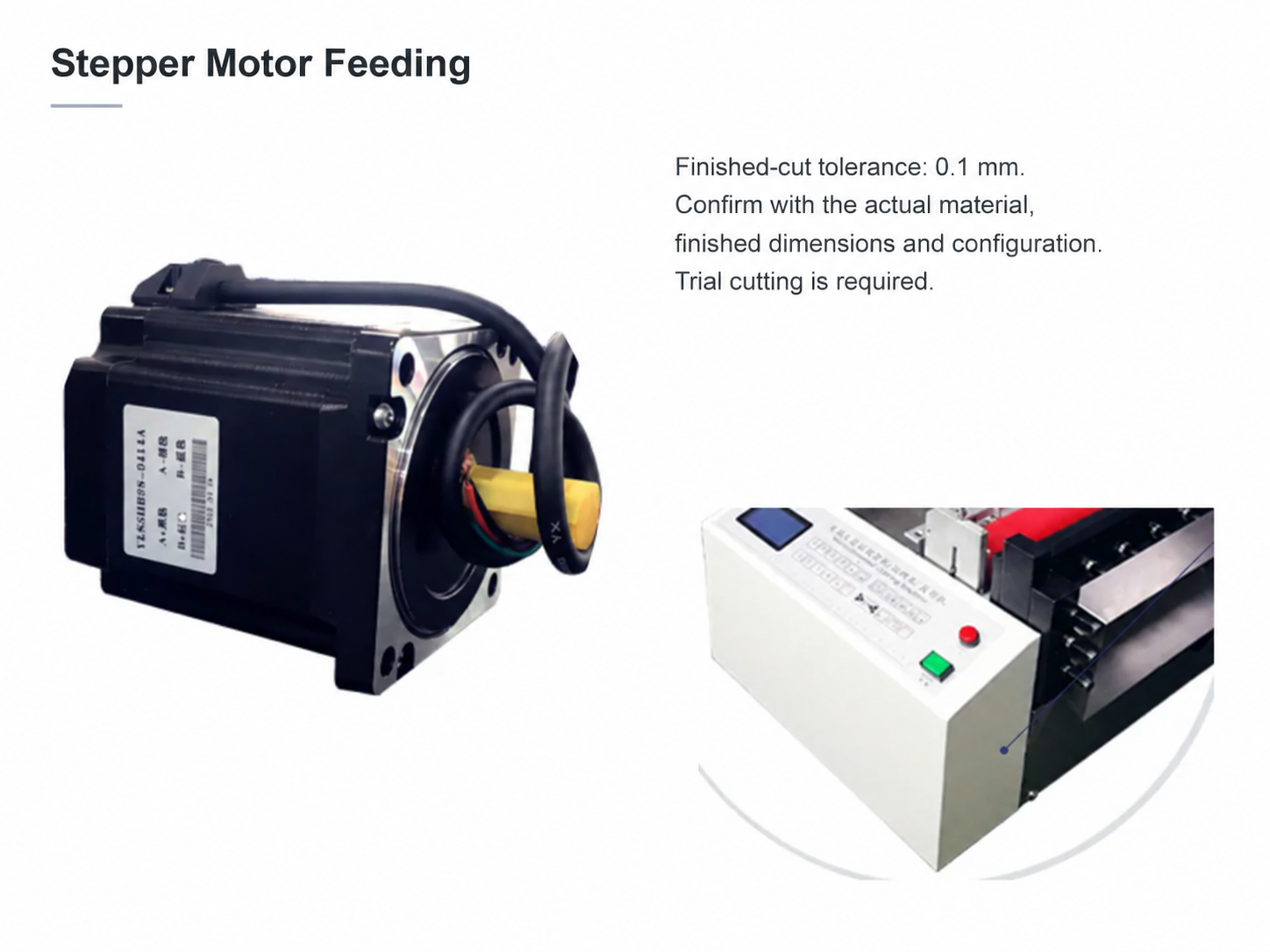
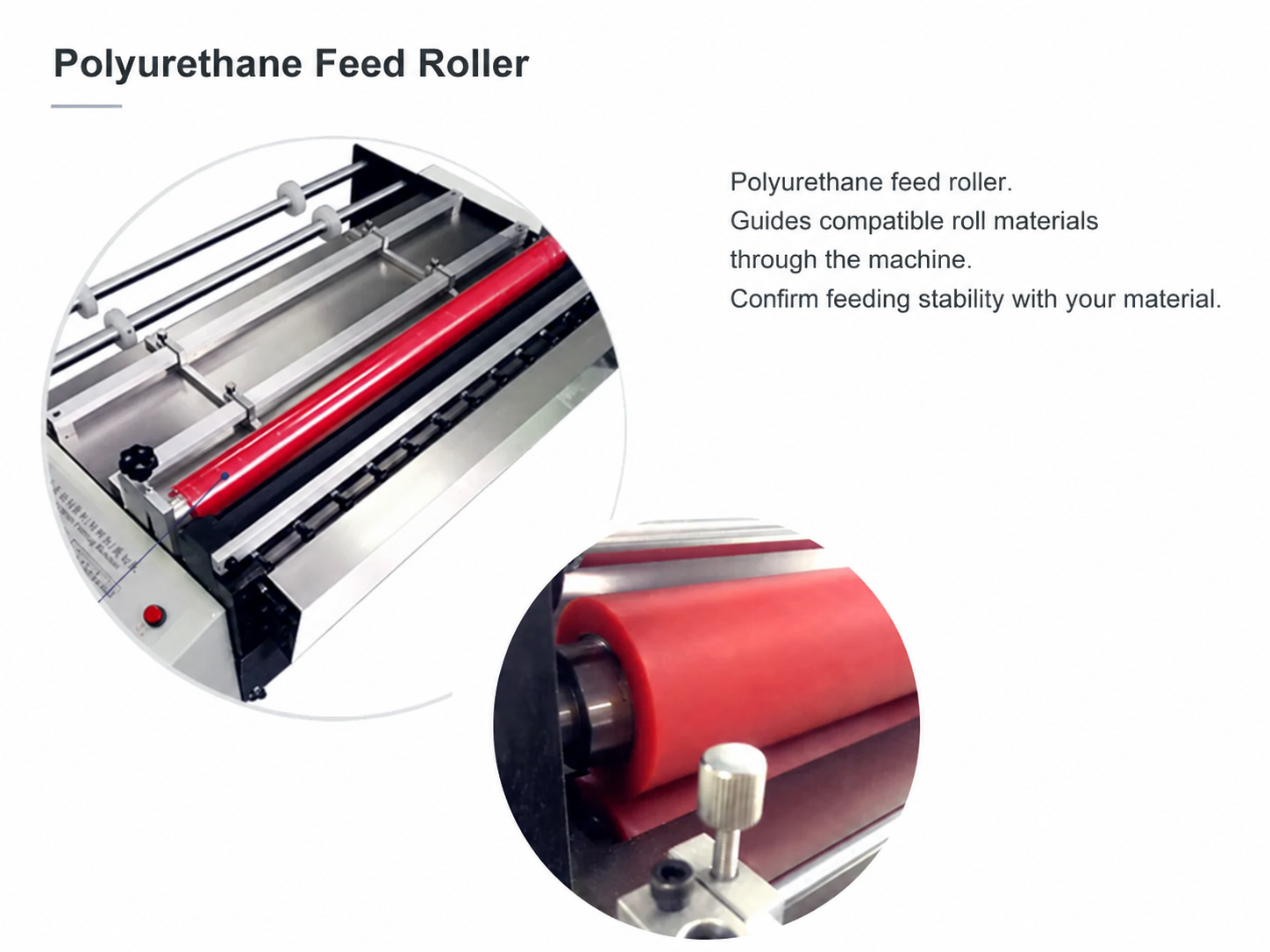
A stepper motor and polyurethane rollers feed the material from the aluminium-profile roll stand.

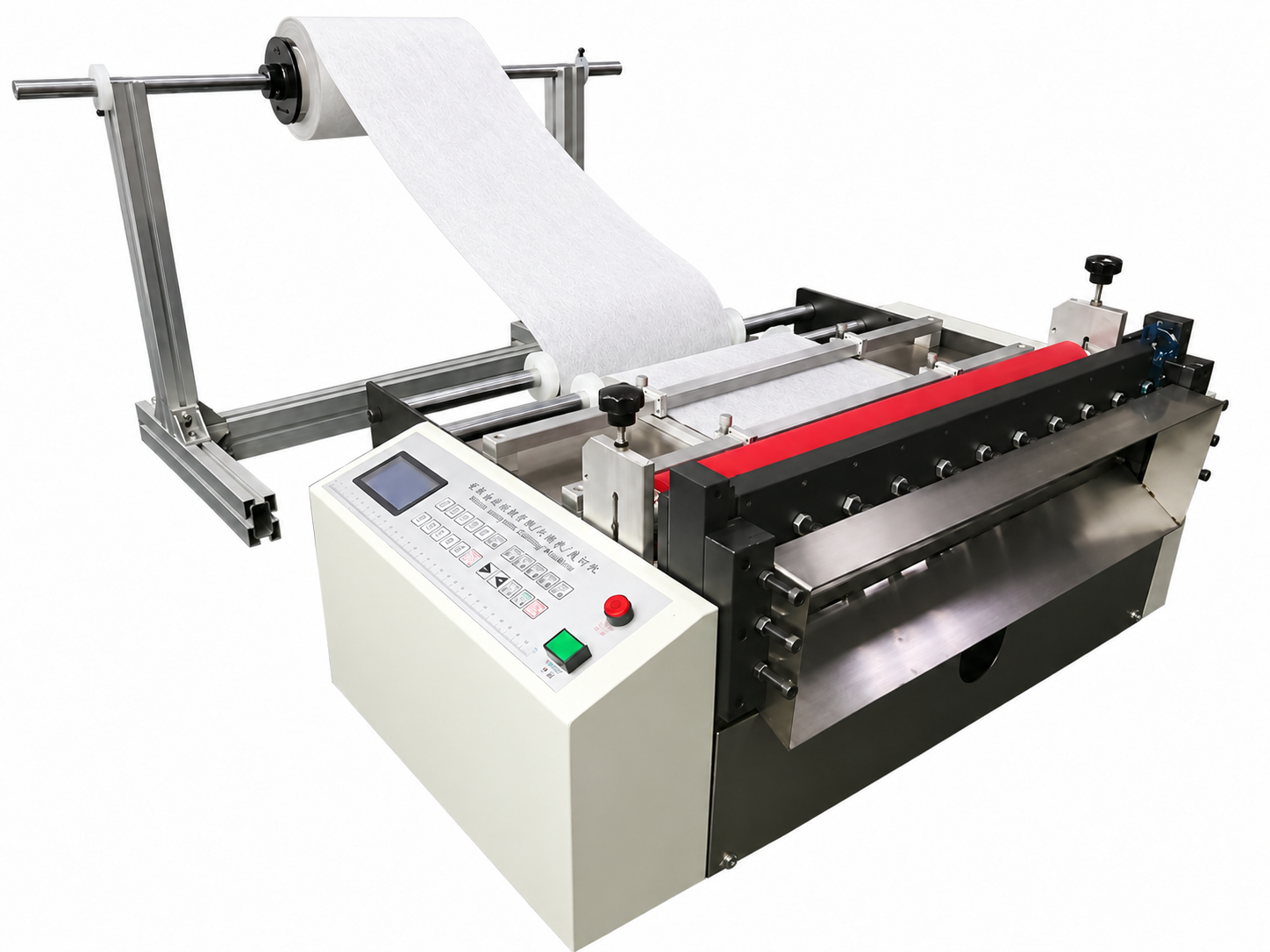
Automatic feeding and cut to length
See this machine’s application
Convert compatible roll materials into sheets and rectangular pieces with the HESPER tabletop roll-to-sheet cutting machine. This automatic cutting machine feeds material from a roll and cross-cuts it to a preset length for repeat production tasks.
Choose from 12 separate width configurations. Share the actual roll width and finished dimensions so we can confirm the usable width for your setup.
The following data describe the 400 mm configuration. Motor power, machine dimensions, weight and other specifications for the remaining widths must be confirmed for the selected configuration.
| Parameter | Specification |
|---|---|
| Model | HYD-400 |
| Machine type | Tabletop roll-to-sheet cutting machine |
| Cutting width (catalogue) | 0.1–400 mm |
| Standard process | Automatic feeding and cut-to-length cross-cutting |
| Longitudinal slitting | Optional longitudinal blades |
| Material thickness | Up to and including 10 mm with standard blades; over 10 mm with a custom blade and configuration assessment |
| Cutting-length setting (catalogue) | 0.5–99,999.9 mm |
| Cutting speed (catalogue) | 34 m/min (catalogue); not pieces per minute. Assess accepted output by trial. |
| Total-quantity setting | 1–999,999 |
| Feed-speed levels | 0–30 (setting levels, not m/min) |
| Functions | Start/stop, cutting delay, cutting interval, batch pause, length compensation |
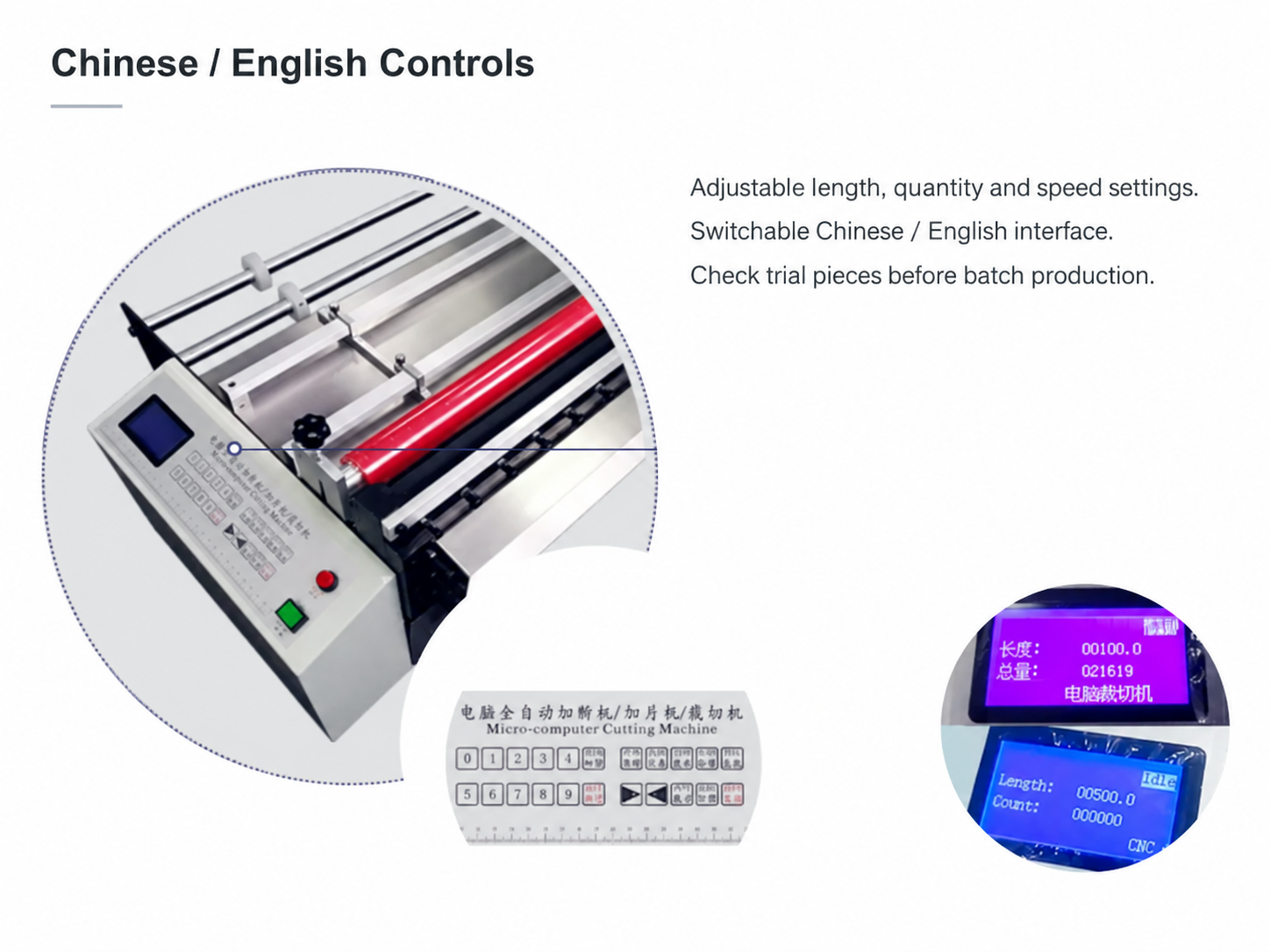
| Control interface | LCD control panel with switchable Chinese/English |
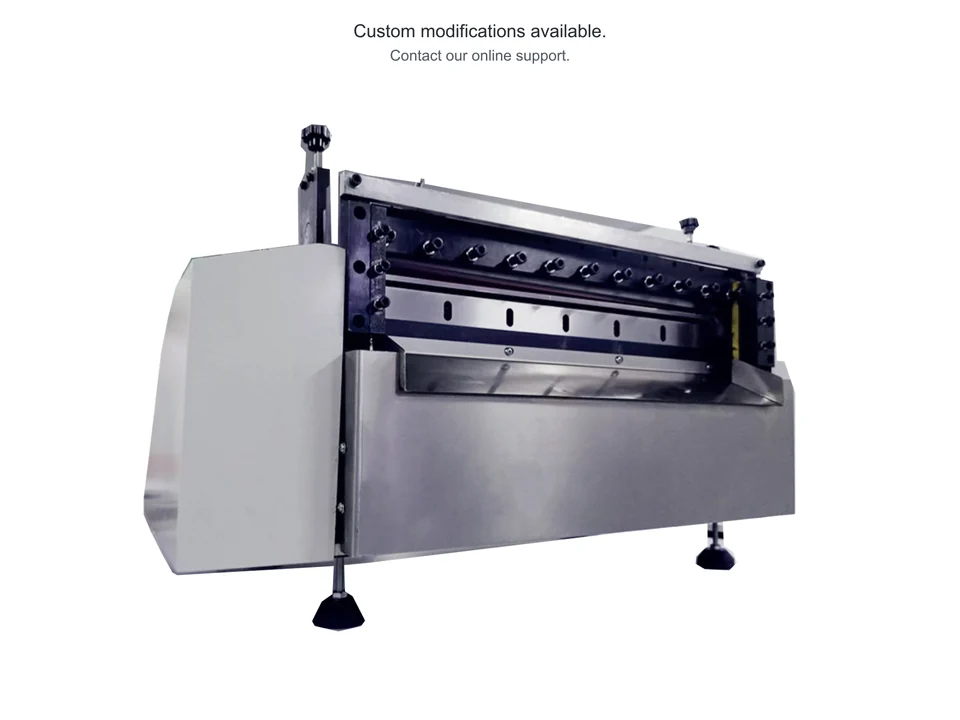
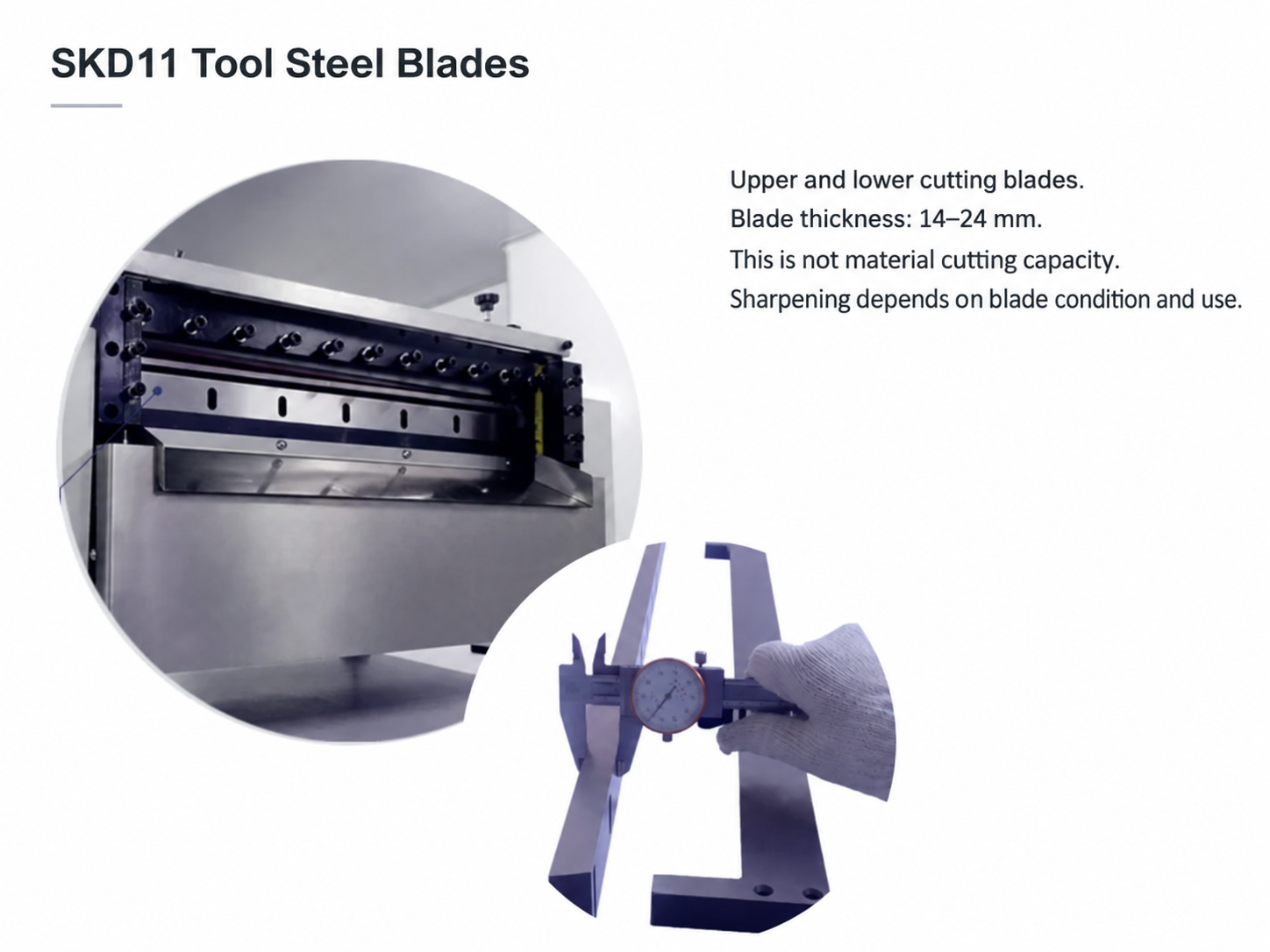
| Blade material | SKD11 tool steel |
| Panel | Stainless steel |
| Feed rollers | Polyurethane |
| Feed motor | Stepper motor |
| Cutting motor | 120 W AC geared motor |
| Machine dimensions (catalogue) | 580 × 700 × 400 mm |
| Machine weight | 70 kg |
| Power supply | Configurable to customer requirements; confirm voltage and frequency |
| Standard accessories | Power cord, No. 3/4/5 wrenches, spare fuse, manual, aluminium-profile roll stand with clamps |
| Export wooden crate | 760 × 660 × 670 mm; packed weight 92 kg |
| Blade thickness | 14–24 mm (blade dimensions, not material cutting capacity) |
| Finished-cut tolerance | 0.1 mm; confirm applicability for the actual material, finished dimensions and configuration by trial |
The cutting-length figures are catalogue settings, while the cutting-width figures are catalogue specifications. Neither establishes achievable finished dimensions or tolerances for every material. Confirm minimum practical length, slitting width, cutting tolerance and accepted output for your application. Confirm lead time, shipping, installation support and warranty terms in the quotation.
A stepper motor and polyurethane rollers feed the material from the aluminium-profile roll stand.
Set the cut length and total quantity on the LCD panel, which switches between Chinese and English.
Add longitudinal blades to split compatible rolls into narrower lanes before cross-cutting.
To use this cut to length machine, set the cutting length and quantity on the LCD control panel with switchable Chinese/English. A stepper-motor feed system with polyurethane rollers advances the material, and the SKD11 blade cuts across its width to produce individual pieces.
Feed-speed levels, cutting delay, cutting interval, batch pause and length compensation help operators set the machine up for different jobs. Check trial pieces and adjust the settings before starting batch production.
Key capabilities:
The table combines catalogue applications with additional materials specified by HESPER. Suitability depends on thickness, hardness, elasticity, compressibility, surface properties, feeding arrangement and blade configuration. Confirm it with an actual sample: inclusion does not establish that every grade, thickness or slitting configuration has been validated.
| Category | Material applications | Trial and configuration details |
|---|---|---|
| Plastic films and bubble wrap | PVC, PET, OPP, PE, PP, CPP, BOPP, POF shrink film, TPU, EVA film, PVA water-soluble film, bubble wrap, battery film and graphene film | Grade, film thickness and width; for bubble wrap, include overall thickness and bubble height. Shrink film is assessed for sheeting, not as a promise of heat-sealing or bag-making capability. |
| Fabrics and textile trims | Nonwoven fabric, polyester fabric, nylon fabric, felt, microfiber fabric, other fabrics, webbing, zipper tape, hook-and-loop tape and rope | Composition, basis weight or thickness, stretch and edge requirements; confirm suitability for slitting separately. |
| Foam, sponge and insulation | EPE foam, EVA foam, PE foam, IXPE foam, other foams, sponge and insulation materials | Density, uncompressed thickness, compressibility and finished dimensions; assess recovery after feeding and the cut edge. |
| Paper, card and packaging | Kraft paper, release paper, PE-coated paper, packaging paper, other paper and card | Basis weight or thickness, coating, roll condition and sheet dimensions. |
| Laminates, protective and adhesive-backed materials | Aluminium foil laminates, metallized film, protective film, release film, self-adhesive materials, double-sided tape and other laminates and adhesive materials | Layer construction, total thickness, adhesive and release liner, including any exposed adhesive. Assess for through-cutting; kiss-cutting is not assumed. |
| Tubing and sleeving | Heat-shrink tubing, PVC tubing, varnished sleeving, fibreglass sleeving, rubber, latex, silicone, nylon and foam tubing, air hose, PTFE tubing and braided copper sleeving | Outside diameter, wall thickness, hardness, profile and end finish; assess separately rather than inferring tube capacity from flat-material thickness. |
| Electronic and insulation materials | Electrical insulation paper, mica sheet and other electronic and optoelectronic materials | Grade, thickness, layer construction and finished dimensions. |
| Leather | Leather and synthetic leather | Thickness, hardness, surface properties and feeding stability. |
| Rubber, silicone and seals | Rubber, silicone, rubber sealing strips and other sealing materials | Hardness, thickness, elasticity and profile. |
| Thin metal and other special materials | Copper strip, nickel strip, nickel sheet, aluminium foil, aluminium strip, other thin metal sheet and special materials | Confirm metal grade, temper, hardness and thickness separately; no 10 mm metal-cutting capacity is claimed. |
Industries listed in the catalogue include electronics, electrical appliances, batteries, wire harnesses, motors, transformers, toys, medical devices, agricultural machinery, automotive and motorcycle parts, and pneumatic tools.
For adhesive-backed materials, identify the adhesive type, liner construction and whether any adhesive is exposed during processing. The process is through-cutting into individual pieces; kiss-cutting should not be assumed.
The 10 mm standard-blade figure must not be read as a 10 mm metal-cutting capacity or a guaranteed tube diameter. Thin metal and tubing need separate confirmation.
Cutting thinner film for packaging? HESPER also offers 300 mm tabletop film cutters for PE, BOPP, CPP, PVC and POF shrink film.
Configured as a slitting and cutting machine with optional longitudinal blades, the machine can divide compatible rolls into narrower lanes and cross-cut them to the programmed length.
This configuration can be assessed for applications such as:
Minimum strip width, blade quantity and usable material width depend on the selected configuration. The 0.1 mm lower figure in the listed width range is not a verified minimum slitting width. Provide the required number of lanes and finished dimensions before ordering.
| Up to and including 10 mm | Standard blades, for compatible materials |
|---|---|
| Over 10 mm | Custom blade required, plus confirmation of the machine configuration |
Thickness alone does not determine cutting suitability. A soft foam, a dense rubber sheet and a rigid laminate of the same thickness may need different configurations.
Materials over 10 mm require a custom blade and an assessment of feeding clearance, material handling and overall machine suitability. This includes 10.5 mm material. A custom blade is not a guarantee that thicker material can be cut. Submit any request for a blade tailored to the material and cut shape with a drawing or sample; HESPER will assess the blade approach and suitability of the complete machine.
See an existing tabletop roll-to-sheet cutting demonstration. Confirm the width and configuration for your material separately.
 Watch Demo on YouTube Opens in a new tab
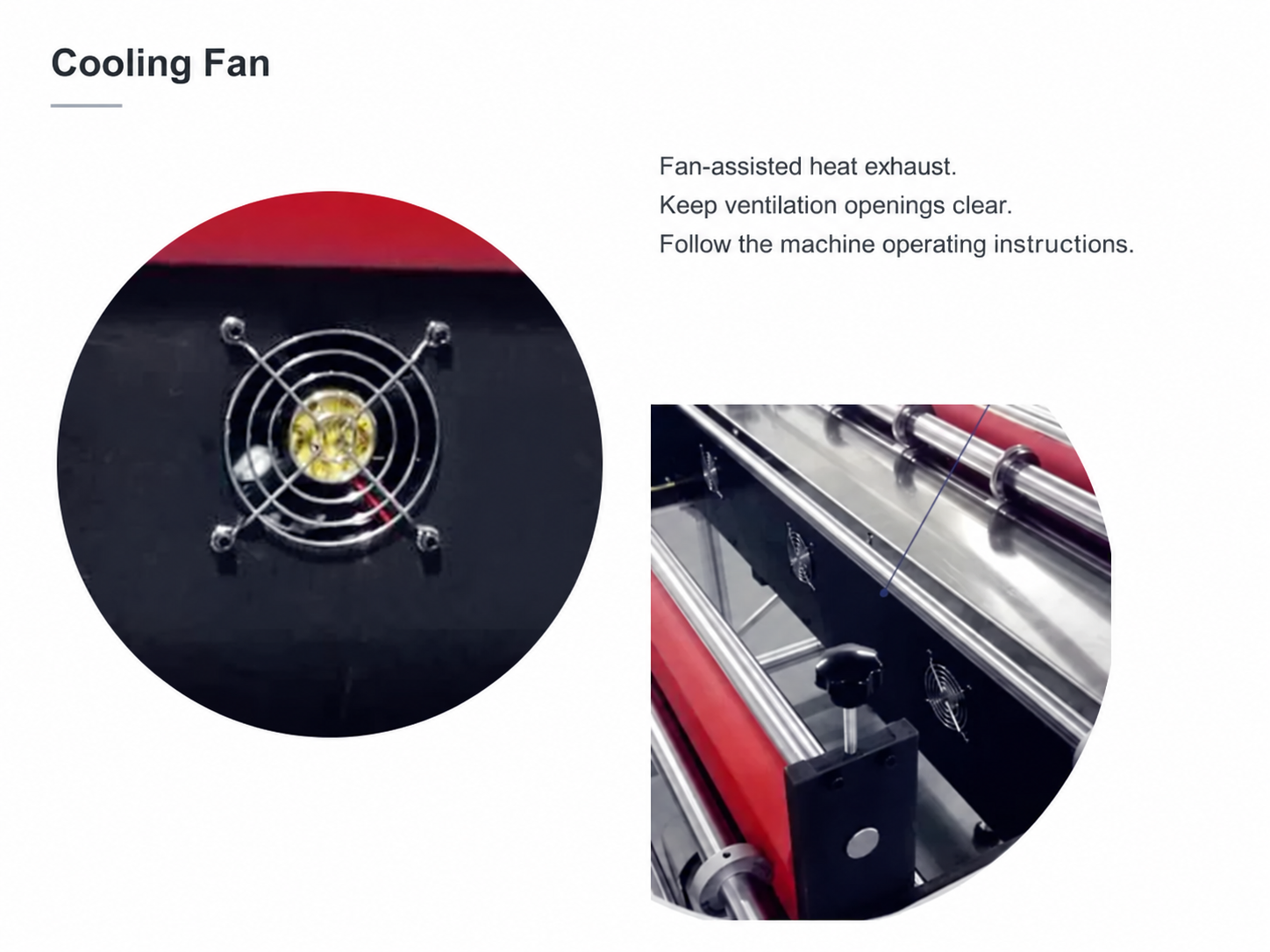
Follow the machine manual, stop the machine and isolate power before blade installation, adjustment or maintenance. These tasks should be performed by personnel familiar with the equipment; keep hands away from feed rollers and blades during operation.
Applications to assess include films, bubble wrap, nonwovens and textile trims, foam, paper, laminates and adhesive materials. The catalogue also lists tubing, insulation, leather, rubber and thin metal applications. Confirm the actual grade, thickness, feeding arrangement and blade configuration with a sample; the list does not establish suitability for every specification.
No. Longitudinal slitting is optional. The standard process feeds the material and cross-cuts it to a preset length. Optional longitudinal blades add slitting for suitable applications.
Nonwoven fabric is a catalogue-listed material. Provide the fabric composition, basis weight or thickness, roll dimensions and finished sheet size so the configuration can be confirmed.
EVA foam, EPE foam, sponge and bubble wrap are catalogue-listed materials. Foam density, compression and bubble height affect feeding and finished dimensions, so confirm the setup with your material.
No. Standard blades are for compatible materials up to and including 10 mm thick. Materials over 10 mm require a custom blade, and feeding clearance and overall machine suitability must also be confirmed.
Thickness alone is not sufficient. Standard blades are for compatible materials up to and including 10 mm; thicker materials require a custom blade. Hardness, density, compressibility and layer construction still require assessment. Confirm thin metal and tubing separately.
Double-sided tape and other adhesive materials are catalogue-listed. Specify the adhesive, coating and release liner so the feeding and blade arrangement can be assessed. The process is through-cutting; kiss-cutting should not be assumed.
No. The 400 mm reference configuration has a catalogue cutting-width range of 0.1–400 mm; the 0.1 mm figure is not a verified minimum slitting width. Minimum strip width, blade quantity and usable material width must be confirmed for the configuration and sample.
The specified finished-cut tolerance is 0.1 mm; confirm applicability for the actual material, finished dimensions and configuration by trial. The catalogue lists a cutting speed of 34 m/min, not pieces per minute. Actual cutting tolerance and accepted output depend on the material, finished length, feeding behaviour, cutting cycle and configuration. Provide your tolerance and production target for assessment with the actual material.
Provide the material name, thickness, roll width and diameter, required cutting length, production quantity and local power supply. Include finished strip widths and lane quantity if longitudinal slitting is required.
Share your material, roll width and finished dimensions so we can assess the setup and prepare a quote. You can attach material photos to your enquiry.
Get a Quote & Add Photos ↗Include material grade, thickness, roll width, diameter, core size and weight, finished dimensions and tolerances. For slitting, add the strip widths and number of lanes.
Share the output target and sample material. Check feeding stability, dimensions and cut edges before confirming the configuration.
Include local voltage and frequency, the destination and your required schedule. Confirm packing, shipping, installation support and warranty in the quotation.