
TAPE CUTTERS · MIXED-WIDTH WEBBING
A bag needs a wide shoulder strap and a narrow loop, both the same length. Most workshops cut them as two separate jobs. If the two webbings suit the same cut, they can go through the cutter side by side and come out cut and sealed together.
A small bag workshop uses two widths of nylon webbing on one backpack, for example 1.5-inch webbing for the shoulder straps and 1-inch webbing for a loop. Both pieces are the same length. Today the operator cuts all the wide pieces, changes the guides, then cuts all the narrow ones, and someone pairs them up again at the sewing table.
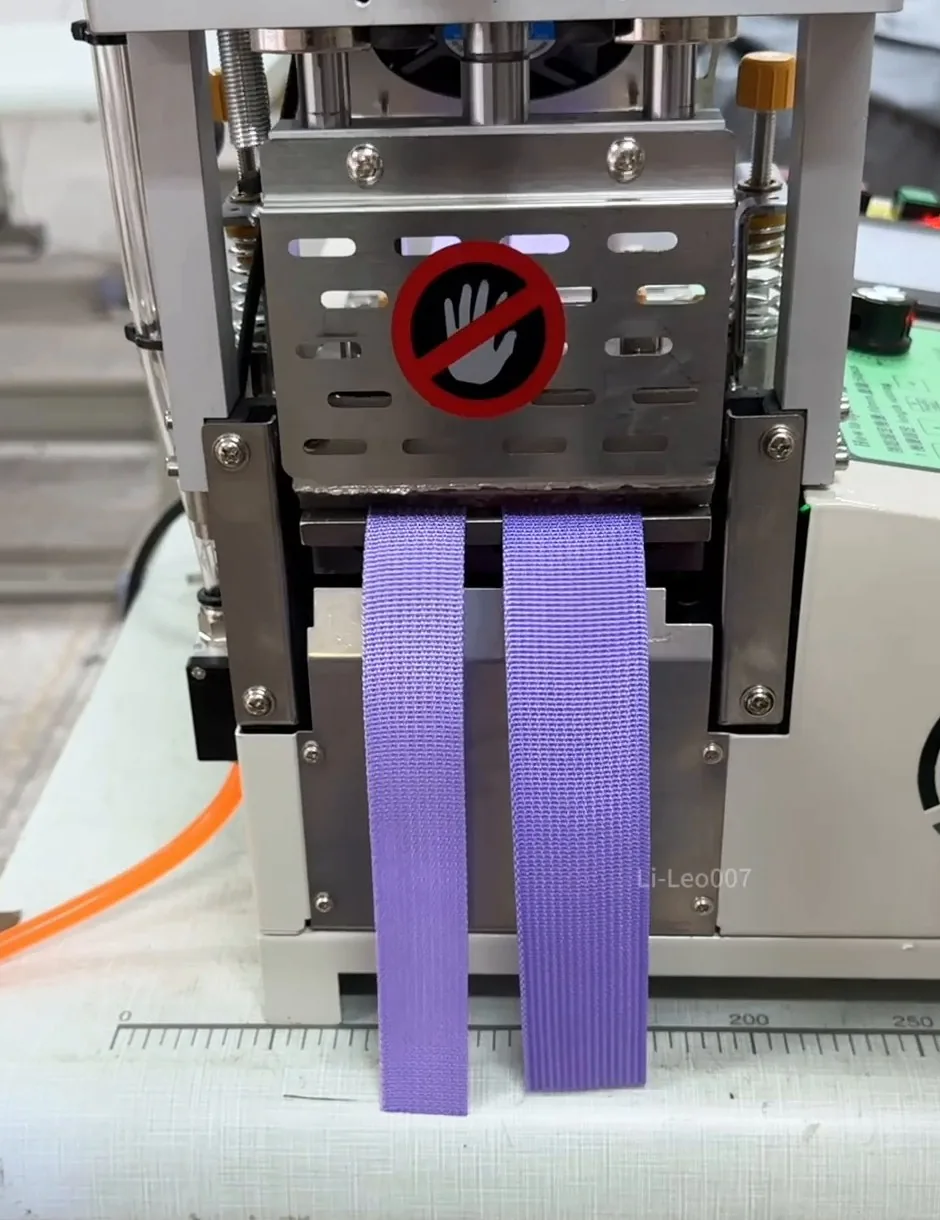
A short video from a webbing cutting line shows another way. A wide strip and a narrow strip run side by side under a hot knife. In the video, one stroke cuts both flat and seals the ends. It asks a fair question: why cut them separately if they can go through together? The answer depends on four things, and they decide whether it works for your order.
THE SHORT ANSWER
Two widths of webbing can be cut together when they need the same length, the same kind of cut end and similar heat or cutting settings, and when both fit side by side inside the cutting width with room for the guides. Guide each strip on its own, feed both from free-running rolls, and check the length and the sealed end of both strips, not just one. If the lengths differ, or one webbing needs a different temperature or a cold cut, run them as separate batches.
- 01 What the video shows
- 02 When two widths can share a cut
- 03 Guide each strip on its own
- 04 One temperature for both
- 05 Check both pieces
- 06 When to cut separately
- → HESPER machines
- ? FAQ
01 · WHAT THE VIDEO SHOWS
A wide strip and a narrow strip, cut flat together
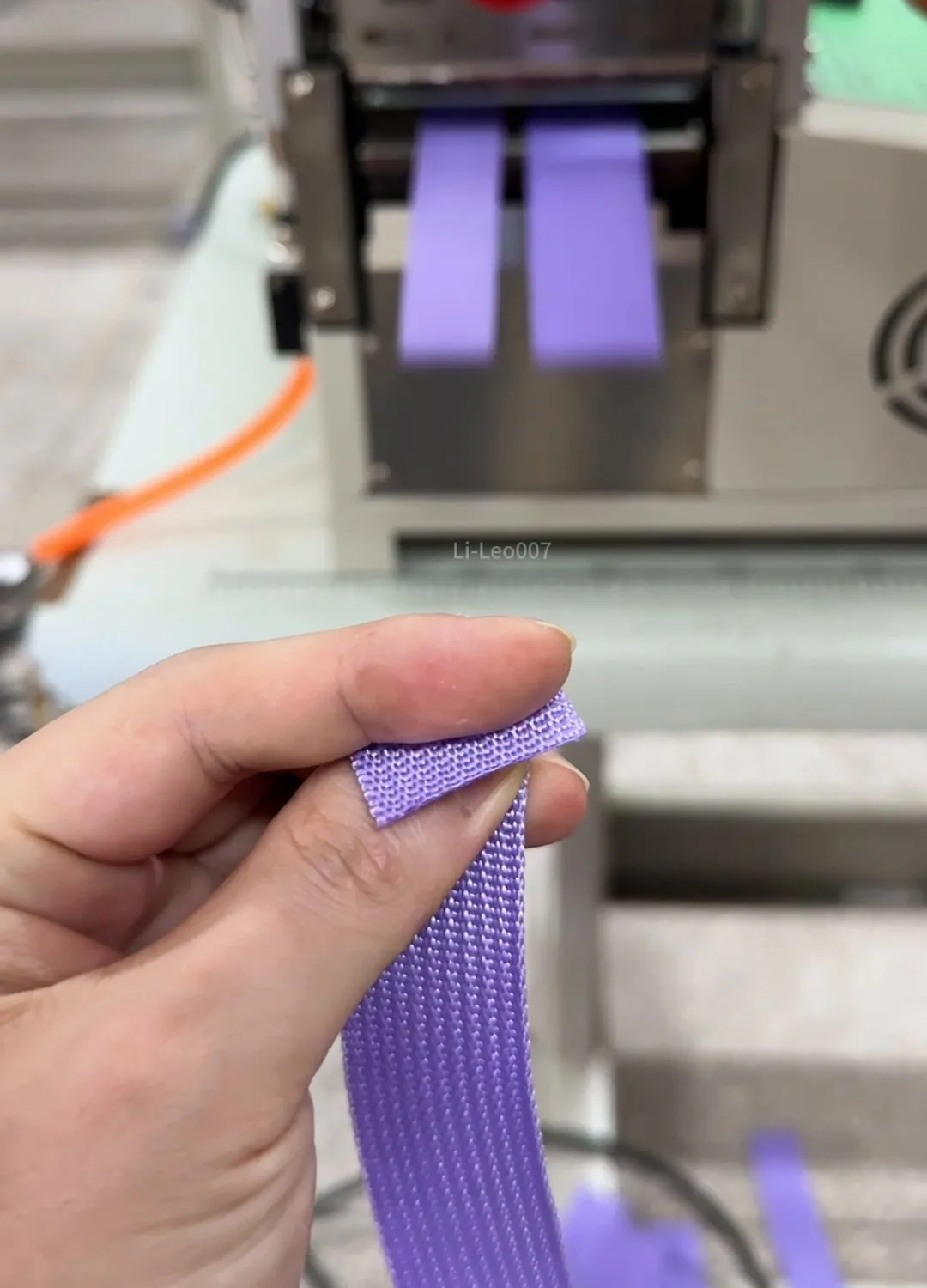
In the video, two purple webbing strips of different widths feed side by side into a hot cutting head. Each stroke cuts both strips flat at the same point. A cut piece held up to the camera shows the end sealed by the heat. The video does not give the widths, the material or the settings, so treat it as a demonstration of the method, not a specification.
02 · WHEN TWO WIDTHS CAN SHARE A CUT
Four conditions
| Condition | Why it matters | If it isn't met |
|---|---|---|
| Same cut length | One feed and one stroke give one length for every strip | Cut each length as its own batch |
| Same end finish | Both strips get the same hot or cold cut | Separate the strip that needs a different cut |
| Similar material and thickness | One temperature and one blade setting must suit both | Test first; separate if one seals badly |
| Both fit the cutting width | The two widths, plus guides and a gap, must sit under the blade | Choose a wider machine or cut separately |
For more on running several strips at once, see cutting several webbing straps at once and two strips, one cut.
03 · GUIDE EACH STRIP ON ITS OWN
Two widths need two lanes
- Set a guide for each strip. The narrow strip needs its own guide, or it will wander beside the wide one.
- Leave a small gap. The strips should not overlap or push each other on the way to the blade.
- Feed from two free-running rolls. If one roll drags, that strip can come out shorter. See why tape feeds crooked.
- Check the feed roller grip. It has to move both strips evenly, even though one is wider.
04 · ONE TEMPERATURE FOR BOTH
Find a setting that seals both ends
On suitable synthetic webbing such as nylon or polyester, a hot knife can seal the end as it cuts. When two strips share the blade, the same temperature has to work for both.
- Start low. Raise the temperature in small steps until both ends seal.
- Watch the thinner strip. If it starts to form a hard bead before the other seals, the two may need separate runs.
- Match the materials. Webbings made from different fibers can react differently to the same heat. See hot knife or cold knife.
05 · CHECK BOTH PIECES
Two strips, two checks
- Measure both. Lay a wide piece and a narrow piece flat and compare each with the setting.
- Look at both ends. Sealed, flat, not frayed and not beaded.
- Try them at sewing. Fold and sew a pair to check the ends at the next step.
- Keep pairs together. Each stroke gives one wide and one narrow piece, ready to bundle as a set for backpack straps, tote bag straps or bag handles.
06 · WHEN TO CUT SEPARATELY
Sometimes two batches are better
- Different lengths. A shared stroke can only give one length.
- One cold, one hot. If one webbing must be cut cold, run it on its own.
- Very different thickness or stiffness. They may feed or seal differently.
- Different quantities. If you need far more of one width, the other roll runs out of step.
HESPER EQUIPMENT
HESPER hot and cold tape cutting machines
Four options, each with hot and cold knife cutting. The tape cutter page shows several webbing strips passing side by side through the cutter, but does not say which options support it, so confirm parallel feeding with your two webbings. Details are on the tape cutter page.
95 MM
95mm EconomyCutting width 1–95 mm. Button control panel for routine cut-to-length work.95 MM
95mm High-SpeedCutting width 1–95 mm. LCD and buttons.210 MM
210mm TouchscreenCutting width 1–210 mm for wider tapes and webbing.310 MM
310mm TouchscreenCutting width 1–310 mm for the widest strips.? FAQ
Mixed-width webbing cutting questions
Can two different widths of webbing be cut at the same time?
Yes, if they need the same length and the same kind of cut, and both fit within the cutting width. The video shows a wide and a narrow strip cut flat together.
Will both ends be sealed?
On suitable synthetic webbing, a hot cut can seal both ends. Test a temperature that seals both strips without beading either.
Can I cut two different lengths together?
No. Strips cut in the same stroke come out the same length. Run each length as its own batch.
Why is one strip coming out shorter?
Usually that roll is dragging or the strip is slipping. Let both rolls run freely and check the feed roller.
Can I mix nylon and polypropylene webbing?
Test first. Different fibers can need different temperatures, and one setting may not seal both well.
How wide a machine do I need?
Add both webbing widths, plus room for the guides and a gap, and choose a cutting width that covers it.
Can I cut 1-inch and 2-inch webbing together?
Their combined width is about 76 mm before guides and a gap. Check that it fits: on a 95 mm machine the margin is small, and a 210 mm machine leaves more room.
What should I send for a quote?
Both webbing widths, materials and thicknesses, the cut length, quantities, the end finish you need and short samples of each.
MIXED-WIDTH WEBBING
Cutting Two Widths as Two Jobs?
Send HESPER both webbing widths and materials, the length and quantity of each, and how the ends are finished. Short samples of both webbings are the quickest way to check whether they can be cut and sealed together.
Send your webbing details · See the tape cutters · sales@hespermachine.com