
TAPE CUTTERS · FEEDING
The strip creeps toward one guide, the ends come out slanted, and nothing on the panel has changed. The fix is often two settings on the feed, and it takes about a minute.
A tape cutter runs straight all morning. A new roll goes on, or someone moves a guide, and the strip starts walking toward one side. A few hundred pieces later the ends are slanted and the edge is riding up the guide.
Often the blade and the length setting are fine, and the strip is simply being pulled unevenly. This guide shows how to see which way it drifts, which screw to turn, and what to look at when the drift comes from somewhere else.
THE SHORT ANSWER
Set the guides so they touch both edges of the strip without squeezing it. Hold the feed button and watch which way the strip drifts. Tighten the pressure screw on the upper feed roller on that side, a little at a time, until the strip runs straight along the guide. Then cut a few pieces and check that the ends are square.
- 01 Why it drifts
- 02 Guides
- 03 Read the drift
- 04 Pressure screws
- 05 Test cut
- 06 Other causes
- → HESPER machines
- ? FAQ
01 · WHY IT DRIFTS
What pulls the strip sideways
On many tabletop tape cutters, including the one in the video, the strip is pulled between a lower feed roller and an upper pressure roller, often called a pinch roller. A spring and a screw at each end of the upper roller set how hard it presses down.
If one end presses harder than the other, the two edges of the strip are not pulled the same way, and the strip turns slowly as it feeds. Loose guides let that small turn build up. Guides that are too tight can cause their own drag on one edge.
| What you see | Likely cause | What to change |
|---|---|---|
| Strip creeps steadily toward one side | Uneven pressure across the feed roller | Tighten the pressure screw on the side it drifts toward |
| Strip wobbles from side to side | Guides set too loose | Bring both guides in to the strip edges |
| Edges curl, scuff or catch | Guides set too tight | Open the guides slightly |
| Drift comes back with every new roll | Roll sitting crooked, or strip pulled off at an angle | Re-seat the roll so the strip comes off in line with the guides |
| Strip curves sideways even off the machine | The tape itself is curved along its length | Not a roller setting. Check the material |
02 · GUIDES
Set the guides to the strip
Start in front of the feed rollers. The guides only need to stop the strip from wandering.
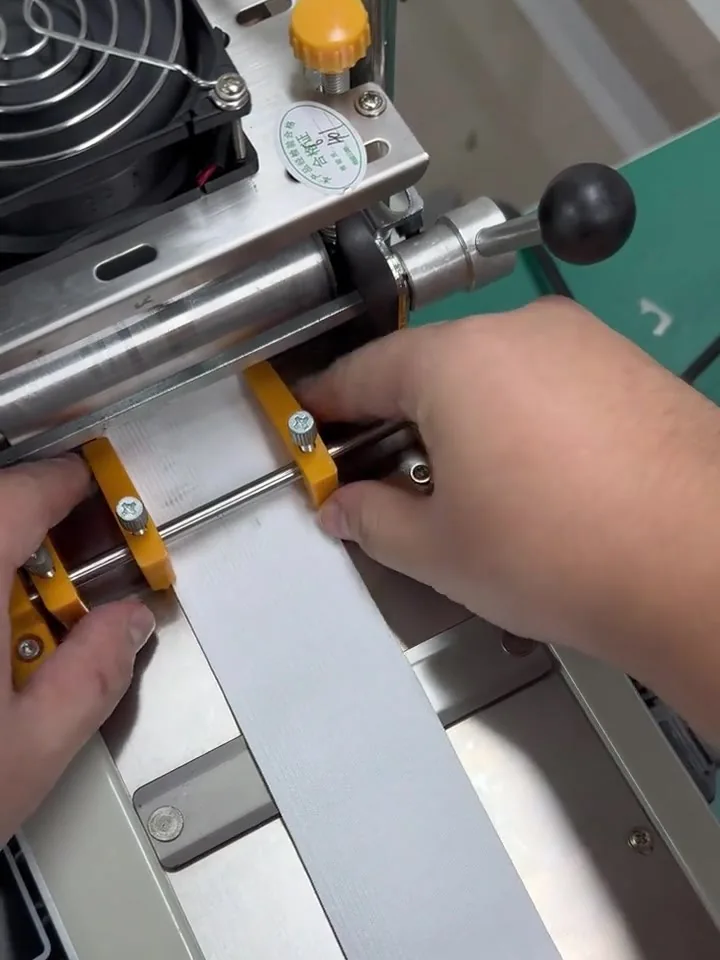
- Bring both guides in. Slide them until they touch the two edges of the strip.
- Hold, don't squeeze. In the video the guides are set just tight enough that the strip can no longer shift left or right.
- Check the edges. If the edges curl or drag, the guides are too tight. Back them off a touch.
03 · READ THE DRIFT
Watch which way the strip goes
Don't cut yet. Hold the feed button so the strip runs forward on its own, and keep your eyes on one edge where it passes the guide.
Within a short run it is clear which way it moves. In the video it drifts noticeably to the left. Note the side before you touch anything, because the fix depends on it.
04 · PRESSURE SCREWS
Tighten the side it drifts toward
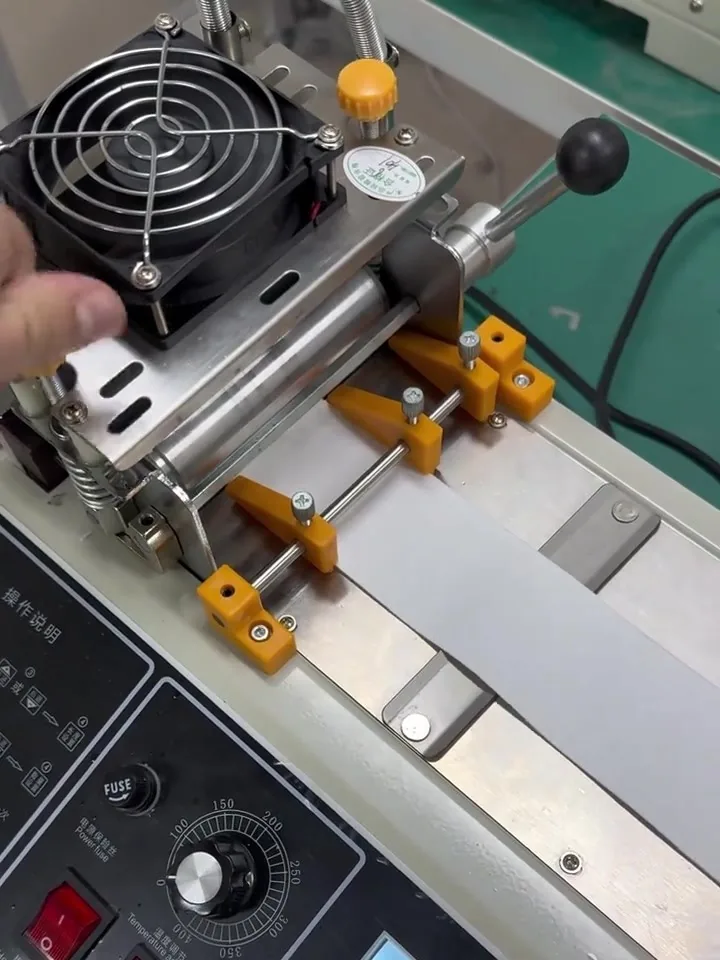
The rule shown in the video is simple: the strip drifts left, tighten the left pressure screw. It drifts right, tighten the right one.
- Small turns. Turn the screw a little, then keep feeding and watch the same edge.
- Stop when it runs straight. When the strip travels along the guide without creeping either way, leave it there.
- Don't overdo it. Too much on one side can send the strip the other way. Then back that screw off slightly.
05 · TEST CUT
Cut a few pieces and check
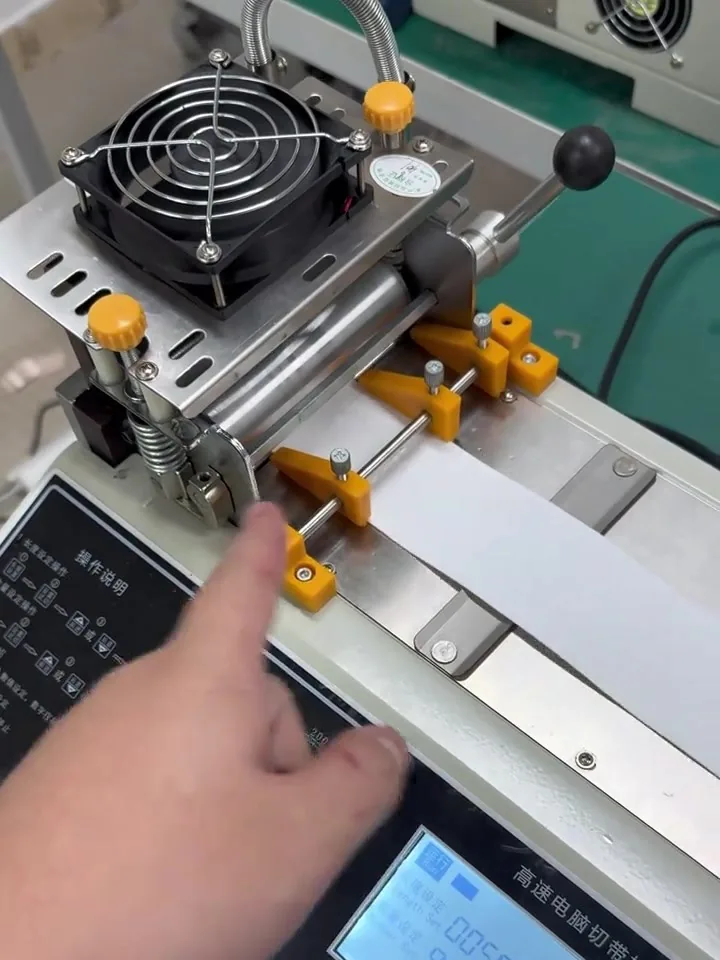
With the strip feeding flat and straight, start the machine and cut a short batch. The ends should be square to the edges, and the strip should hold the same line between cuts. In the video, after the adjustment the strip feeds flat and no longer wanders left or right.
06 · OTHER CAUSES
When it isn't the feed rollers
If the pressure is balanced and the strip still drifts, look further back along its path.
- The roll. A roll sitting at an angle on its holder, or a strip coming off it to one side, pushes the strip sideways before it reaches the guides.
- The material. Lay a length flat on a table. If it curves sideways on its own, no roller setting will make it run straight.
- Stretchy or very soft tapes. Elastic and thin ribbon move more easily under uneven pull, so small differences show up sooner.
If the strip runs straight but the cut ends are still slanted, the feed is not the problem. Look at the cutting side instead.
HESPER EQUIPMENT
HESPER hot and cold tape cutting machines
Four options, each listed with hot and cold knife cutting. Details and specifications are on the tape cutter page.
95 MM
95mm EconomyCutting width 1–95 mm. Button control panel for routine cut-to-length work.95 MM
95mm High-SpeedCutting width 1–95 mm. LCD and buttons.210 MM
210mm TouchscreenCutting width 1–210 mm for wider tapes and webbing.310 MM
310mm TouchscreenCutting width 1–310 mm for the widest strips.? FAQ
Tape cutter feeding questions
Why does my tape cutter feed crooked?
Usually because the upper feed roller presses harder at one end than the other, or because the guides are too loose to hold the strip in line. A roll sitting at an angle or a curved tape can also push the strip sideways.
Which pressure screw do I tighten?
The one on the side the strip drifts toward. If it creeps left, tighten the left screw a little and keep feeding until it runs straight.
What does the pinch roller do on a tape cutter?
It is the upper roller that presses the strip down onto the feed roller, so the strip moves forward with it. The springs and screws at each end set how hard it presses, and keeping that pressure even is what keeps the strip running straight.
How tight should the guides be?
Just touching both edges. They should stop the strip from moving side to side without curling or dragging the edges.
Should I cut while adjusting?
No. Jog the feed and watch the edge first. Cut a few test pieces only once the strip is running straight.
Why are the ends slanted when the strip feeds straight?
Then the feed is not the cause. Look at the cutting side of the machine rather than the rollers.
The drift comes back with every new roll. Why?
Check how the roll sits on its holder and the angle at which the strip leaves it. If the strip enters the guides from one side, it carries that pull into the rollers.
Does this work for elastic, ribbon and webbing?
The same two settings apply. Stretchy and very soft tapes react faster to uneven pull, so make smaller turns and give them a longer run before you judge.
FEEDING
Strip Still Wandering?
Include the material, strip width and thickness, and roll size. Add material photos to the enquiry form and attach short feeding videos to an email.
Submit material details and photos · Email a feeding video · See the hot and cold tape cutter range