
TAPE CUTTERS · SHOELACES AND CORD
Shoelaces and cords look like the easiest thing to cut. Then the ends unravel before the tips go on, round cord rolls in the guides and pairs come out a few millimeters apart. Here is how to set up a tape cutter for laces and cord.
A small brand sells replacement laces in four lengths. Every week someone measures and cuts a few hundred pieces from the roll, then sends them out for tipping. The polyester laces are fine, but the cotton ones fray before they reach the tipping machine, and a few pairs come back with one lace longer than the other.
The same job comes up with drawcords, bag handle cords and belt-loop strips. HESPER lists shoelace material and belt-loop strips among the tape cutter applications, prepared in repeat lengths for tipping, sewing or assembly. The setup depends on two things: the shape of the lace and what it is made of.
THE SHORT ANSWER
Guide flat laces to their width and round cord to its diameter, with the feed roller just firm enough not to slip. Use a hot knife on suitable polyester and nylon laces so the ends stay closed until tipping, and keep the end small enough for the tip to fit. Cut cotton laces cold and tip them soon. Agree whether the set length includes the tips, set the quantity in even numbers for pairs, and check pairs side by side.
- 01 Flat laces and round cord
- 02 Hot or cold cut
- 03 Lengths and tips
- 04 Cutting in pairs
- 05 Handle cords and holes
- 06 Check through the batch
- → HESPER machines
- ? FAQ
01 · FLAT LACES AND ROUND CORD
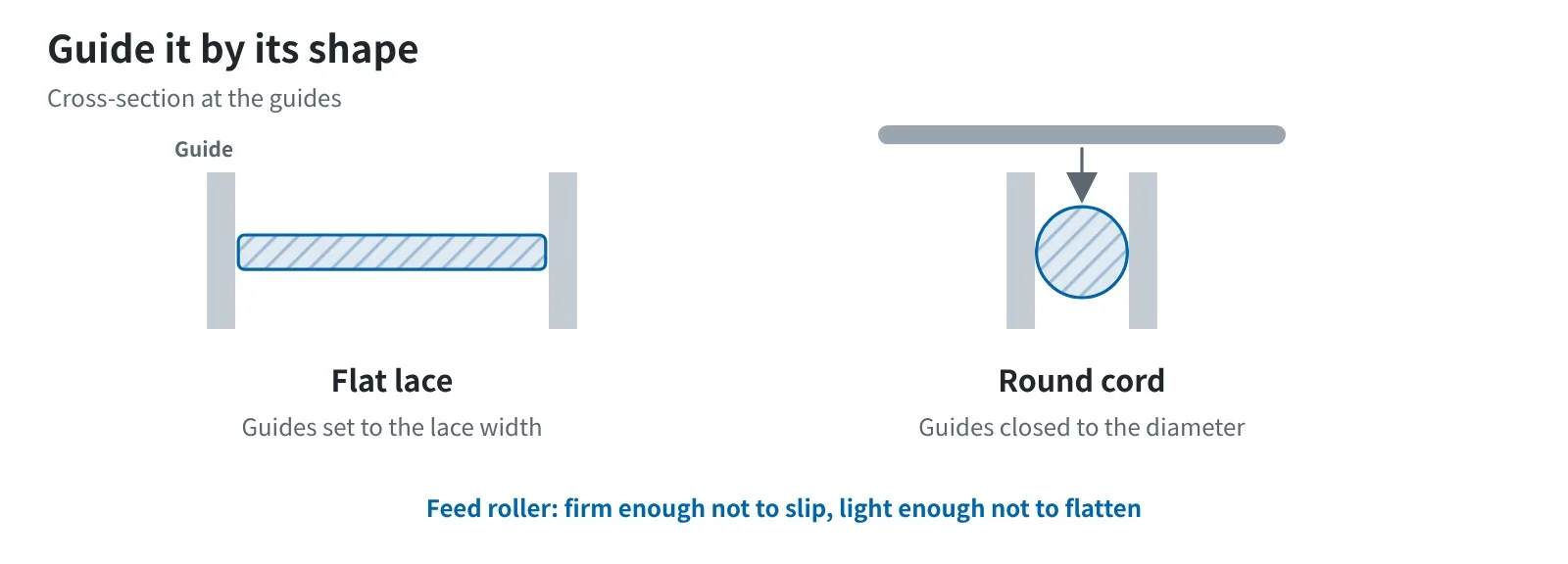
Guide it by its shape
Flat laces behave like narrow tape. Round cord does not lie flat and can roll or twist on the way to the blade.
| What you see | Likely cause | What to change |
|---|---|---|
| Flat lace twists before the cut | Guides too wide for the lace | Set the guides to the lace width |
| Round cord rolls or wanders | Guides not set to the diameter | Close the guides to the cord diameter |
| Cord flattened or marked | Feed roller pressed too hard | Ease the roller pressure until it just doesn't slip |
| Pieces short or uneven | Stretchy cord pulled during feeding | Feed from a loose supply; see cutting elastic without stretching it |
| Cut end angled | Lace not feeding straight | Check the guides; see why tape feeds crooked |
02 · HOT OR COLD CUT
Choose by fiber, and by the tip
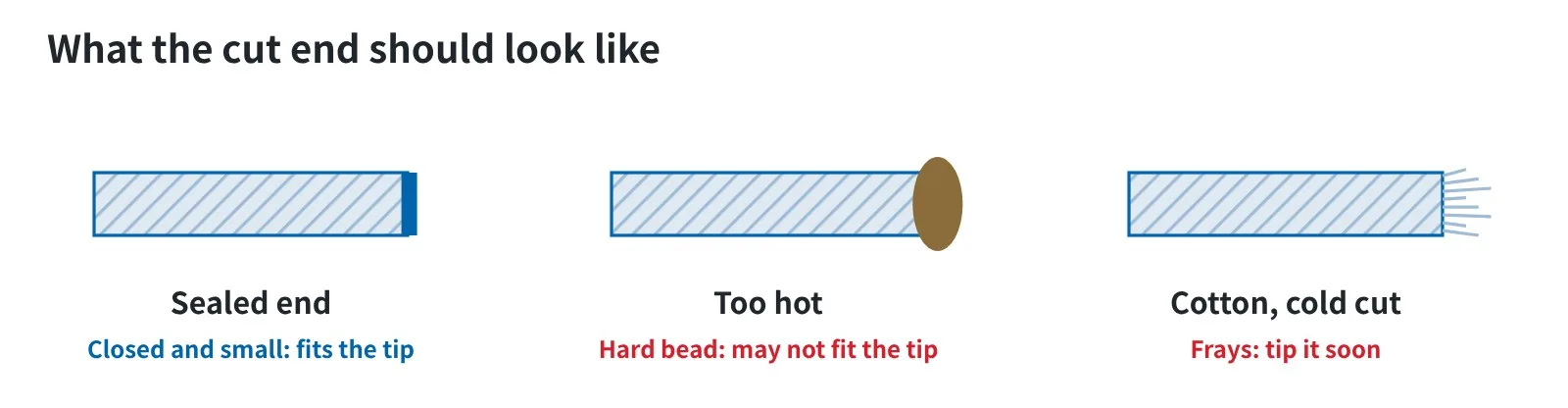
- Polyester and nylon: hot cut. On suitable synthetic laces, the heated blade can seal the end so the braid stays closed until tipping.
- Keep the end small. Too hot and the end can turn into a hard bead. If the lace goes into a tip, check that the sealed end still fits.
- Cotton: cold cut. Cotton doesn't melt, so heat won't seal it. Cut cold, handle gently and tip soon.
- Blends and waxed laces: test. Cut a few pieces each way and check them at the tipping step. See hot knife or cold knife.
03 · LENGTHS AND TIPS
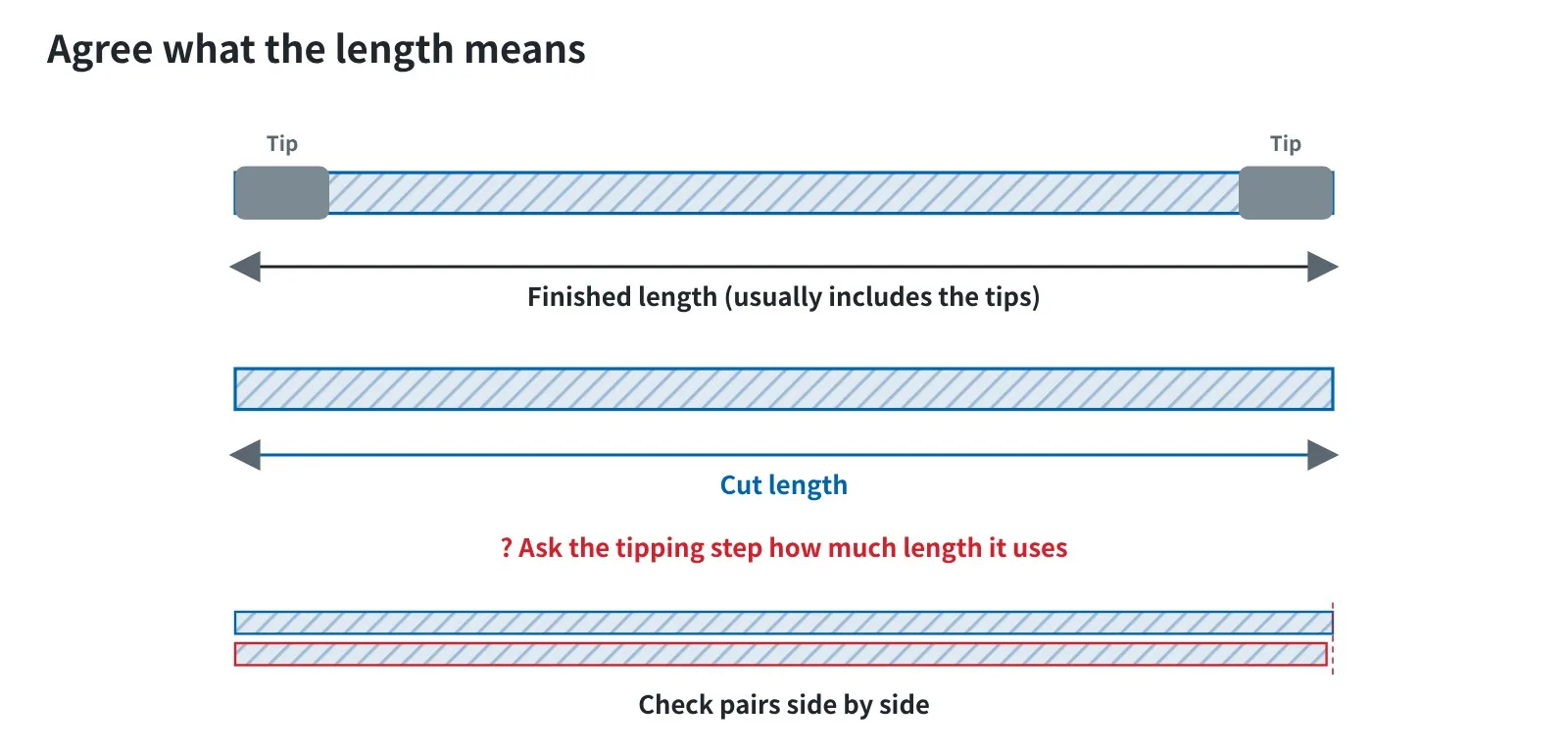
Agree what the length means
A finished lace length usually includes its tips. Before you set the machine, agree whether the cut length is the finished length or allows for the tipping step.
- Ask the tipping step. Find out how much length tipping uses, if any, and add it to the cut length if needed.
- One length per batch. Run each length as its own batch and bundle it before changing the setting.
- Measure relaxed. Lay pieces flat, without pulling, and compare with the setting.
04 · CUTTING IN PAIRS
Two laces that match
- Even quantities. Set the quantity to an even number so every batch makes complete pairs.
- Check pairs side by side. Lay two pieces together. A difference shows at a glance.
- Keep pairs from the same run. Pieces cut one after the other come from the same part of the roll.
05 · HANDLE CORDS AND HOLES
When the cord needs more than a cut
HESPER's cutting and punching machine lists shoelaces, backpack straps and bag handle cords among its materials. For handle cords, send the thickness, cross-section and hole pattern so suitability can be checked.
- Hole pattern. Give hole diameter, count, spacing and edge distance on a drawing.
- End shapes. Straight, angled and other profiles are shown on the product page; confirm them with a sample.
06 · CHECK THROUGH THE BATCH
First pieces, then now and then
- Measure the first pieces. Relaxed, laid flat.
- Look at the ends. Closed, not frayed, not beaded.
- Try a tip. Send a few pieces through tipping before the full run.
- Recheck as the roll shrinks. Measure a piece now and then.
HESPER EQUIPMENT
HESPER machines for laces and cord
Specifications are as listed on each product page. Send a sample of your lace or cord to confirm the cut.
LACES AND STRIPS
Hot and Cold Tape CuttersFour options, cutting width 1–95 mm up to 1–310 mm, cut length 1–99,999 mm, hot and cold knife. Shoelace material and belt-loop strips are listed applications. View the tape cuttersCORDS WITH HOLES
Webbing & Handle Cord Cutting and Punching MachineThree configurations with 90–95 mm cutting width, plus a 100 mm keypad version. Cut length 1–99,999 mm, hot and cold knife, 110 pieces/min reference cutting rate at 50 mm (three configurations). Lists shoelaces and bag handle cords. View the machine? FAQ
Shoelace and cord cutting questions
Can a tape cutter cut shoelaces?
Yes. Shoelace material is a listed application. Guide it to its width or diameter and test the cut with your laces.
How do I stop laces fraying before tipping?
Hot cut suitable polyester and nylon laces to seal the end. Cotton doesn't seal with heat, so cut it cold and tip soon.
Will a sealed end still fit in the tip?
It should, if the temperature is right. Too much heat makes a bead. Check a few pieces at the tipping step.
Can it cut round cord?
Round cord needs guides set to its diameter and light roller pressure. Send a sample with its diameter to confirm.
Does the machine fit the tips?
No. It cuts laces and cord to length. Tipping is a separate step.
How should I cut laces in pairs?
Set even quantities, keep pieces from the same run together and check pairs side by side.
What should I send for a quote?
Lace or cord material, flat width or round diameter, cut lengths, daily quantity, the end finish you need and a short sample.
SHOELACES AND CORD
Still Cutting Laces by Hand?
Send HESPER the lace or cord material, flat width or diameter, the lengths and quantities you cut, and how the ends are finished. A short sample is the quickest way to find the right cut and setup.
Send your lace details · See the tape cutters · sales@hespermachine.com