
Flexible circuit makers often buy their base material on the roll but work in sheets. A flexible printed circuit manufacturer in Europe recently asked us for exactly that: a simple machine to cut rolls of PET, polyimide (PI) or PEN film laminated with a thin layer of aluminum or copper into sheets. Their rolls are up to 420 mm wide, and the longest sheet they need is 1500 mm.
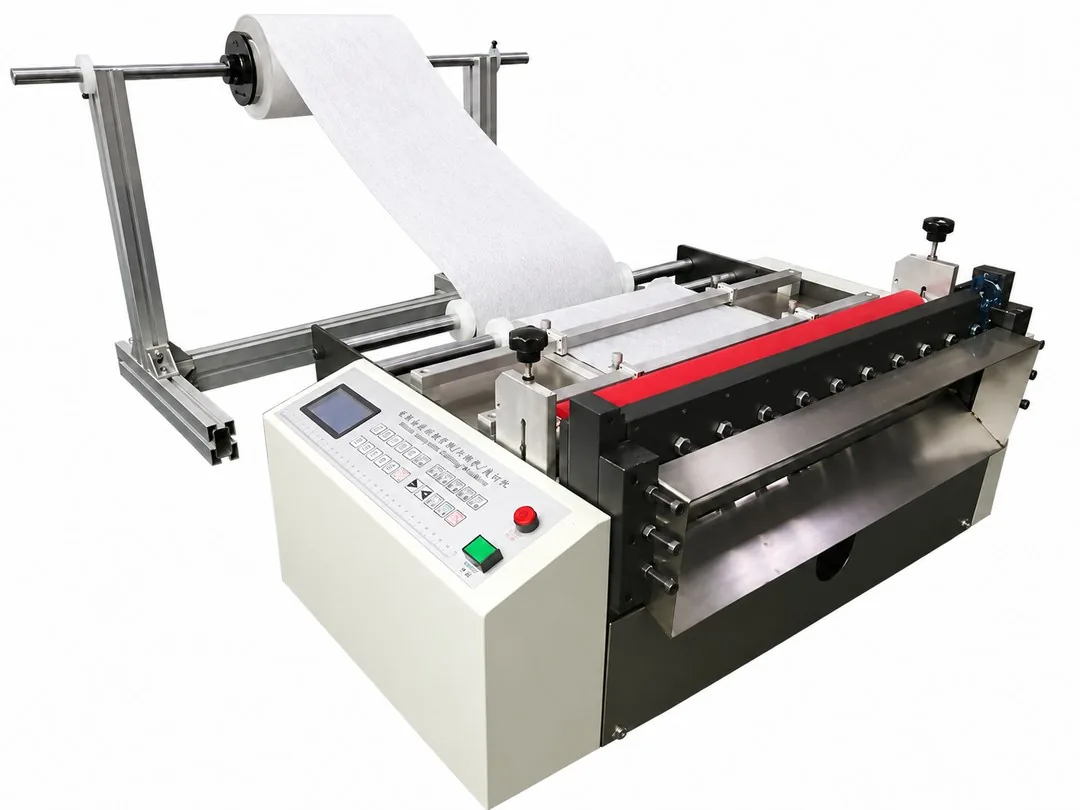
A tabletop roll-to-sheet cutter is designed to feed material from a roll and cross-cut it to a set length. Whether it suits a particular laminate comes down to a few practical questions: which width to choose, what happens to a sheet one and a half meters long once it is cut, and how a film-and-metal laminate behaves at the blade. Answering them before ordering saves a lot of back-and-forth later.
Pick the width for the roll, not the sheet
Roll-to-sheet cutters are built in separate width configurations rather than one machine that covers every size. The HESPER tabletop range comes in 300, 400, 500, 600, 700, 800, 1000, 1200, 1300, 1500, 1600 and 1800 mm specifications. For a 420 mm roll, the 500 mm configuration is the first option to evaluate, with usable width and guide space checked against the actual roll.
Leaving some room beyond the roll width is useful. Laminate rolls do not always wind perfectly true, and the material guides need space to keep the web straight as it enters the feed rollers. If the same machine will later run narrower rolls, the guides can be repositioned, with stable, straight feeding checked for those narrower materials.
Plan where a 1500 mm sheet will go
Sheet length is set on the control panel, and the reference configuration lists a cutting-length setting well beyond 1500 mm, to be confirmed for the width you choose. For long sheets, check straight feeding over the full length, finished dimensions and outfeed support together. Trial the intended production length rather than relying only on short pieces. A 1.5 m sheet of thin laminate leaves the blade with nothing under most of its length. Left to hang or slide off the bench, it can crease, pick up scratches or fall out of order with the sheets before it.
A flat support table at the outfeed, at least as long as the longest sheet, can help support long sheets and reduce hanging and dragging; the surface should be clean and aligned with the outfeed height. Where sheets need to be carried away from the blade automatically, HESPER also offers a cutter with a pre-feeder and conveyor discharge in four working widths: 300, 400, 500 and 600 mm. For a 420 mm roll, discuss the 500 or 600 mm configuration and check whether the conveyor support length and discharge arrangement suit 1500 mm sheets.
Film and metal behave differently under one blade
A laminate puts two very different materials under the same cut. The film layer, whether PET, PI or PEN, is tough but flexible. The aluminum or copper layer is thin but behaves like metal: the cut can leave a small burr or a slightly turned edge, depending on the metal, thickness, blade and setup. Some laminates also have an adhesive layer between film and foil, which can behave differently again at the cut line.
That is why the first trial sheets are worth looking at closely along the cut edge. Check whether the metal layer is cut cleanly, whether it stays bonded to the film right up to the edge, and whether there is any burr on the metal side. If the sheets go on to imaging, etching or lamination, those are the details that matter downstream. The cut is a full through-cut into separate sheets; kiss-cutting through only one layer is a different process and should not be assumed.
Protect the metal surface
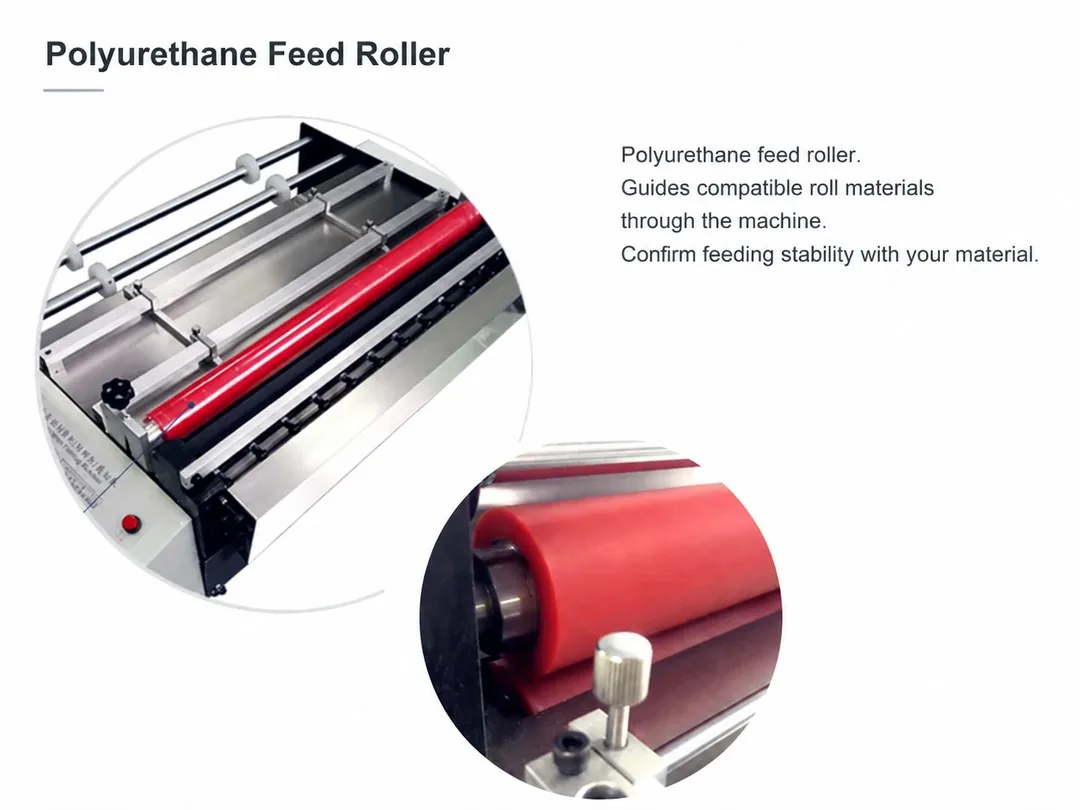
Thin copper and aluminum surfaces mark easily. The feed rollers on the HESPER roll-to-sheet range are polyurethane, but evaluating a laminate means checking both stable feeding and any pressure marks or scratches on the metal surface, rather than judging by roller material alone. Clean rollers matter too, because a small particle pressed into a soft foil can leave recurring marks on subsequent sheets.
If your laminate comes with a protective film on the metal side, trial it with the protective film in place and check feeding, cut edges and subsequent removal. If not, run a few sheets and inspect the metal surface under good light before committing a whole roll.
Expect some curl from the roll
Laminate wound on a core usually keeps some memory of the roll, and a long sheet shows it more than a short one. The cutter cuts the sheet; it does not flatten it. If your next step needs flat sheets, think about how they will be stacked or weighted after cutting, and include that in the trial so you see the real result rather than a single sheet on the bench.
For copper foil in particular, our article on testing wrinkles, edge damage and sheet flatness goes further into how to check sheets after cutting.
What to send for a quotation
A useful enquiry describes the laminate as well as the dimensions. Tell us the film type and thickness, the metal type and thickness, whether there is an adhesive layer or protective film, the roll width, outer diameter, core size and weight, the range of sheet lengths you cut, and roughly how many sheets you need per day. Mention any requirements for the cut edge or for sheet length and squareness.
Start with photos and the layer construction of each laminate, then agree the sample quantity and length. Samples need to allow feeding, edge quality and outfeed handling to be assessed at the actual sheet length; a short offcut alone is not enough for a 1500 mm sheet. You can see the full range on the HESPER roll-to-sheet cutting machine page.
See the roll-to-sheet cutting machine · Send your laminate details · sales@hespermachine.com