
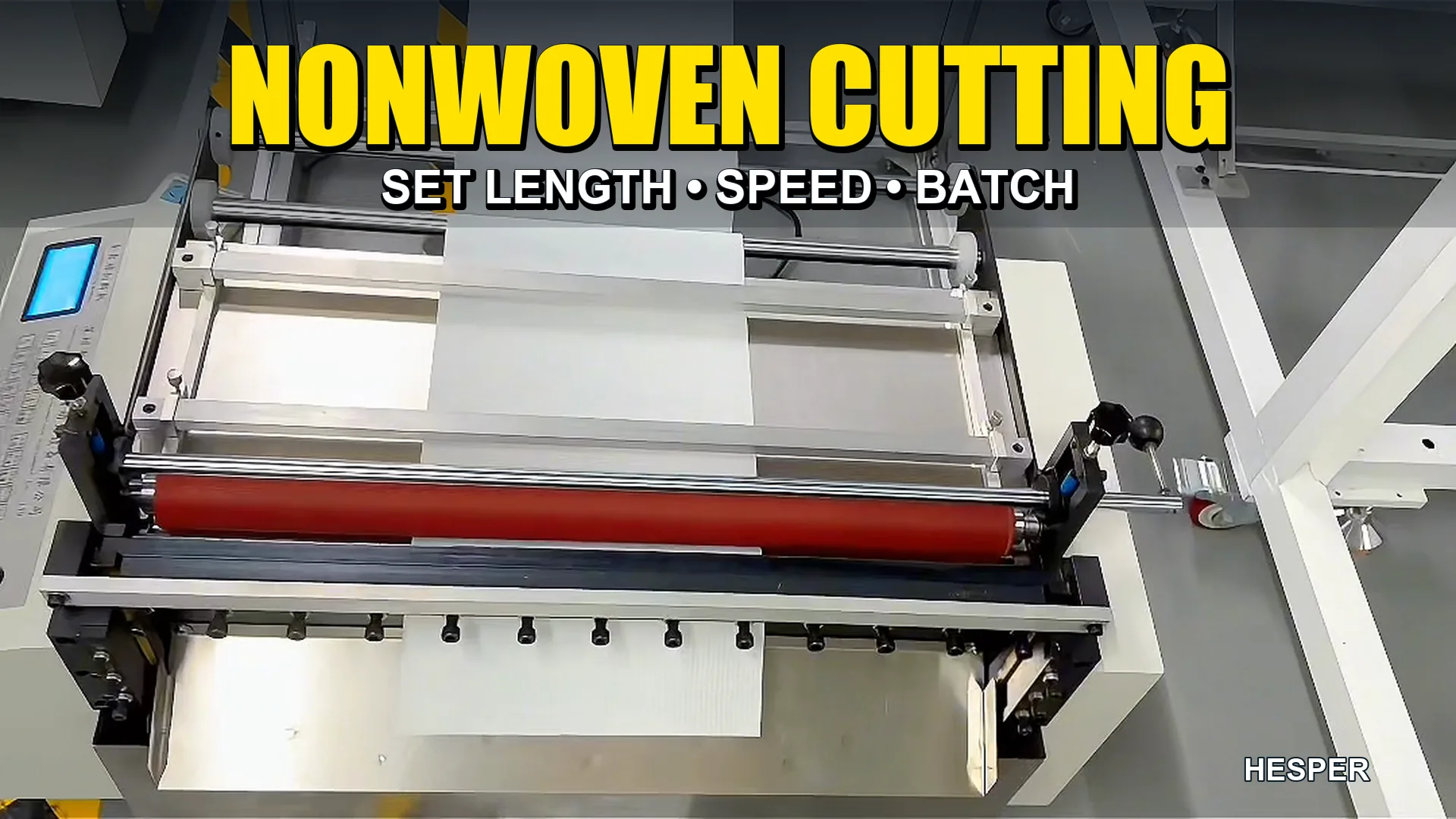
Disposable face towels, dry wipes and other nonwoven wipes usually start as nonwoven fabric on a roll. To sell or pack them, the roll needs to be cut into flat sheets of a consistent size and counted in batches. A roll to sheet cutting machine feeds the web forward and cuts across its width at a set length.
This guide follows a short demo video in which a small automatic cutting machine cuts a face towel nonwoven into 100 mm sheets. It explains each setting in plain language and lists what to check before you choose a machine. The demo machine is not identified as a specific HESPER model.
This guide covers roll-to-sheet cutting only. It does not establish embossing, folding, sanitising or packaging functions, or prove that the finished material meets face-towel use requirements.
 ▶
What the demo shows
| Item | In the video | What it means for you |
|---|---|---|
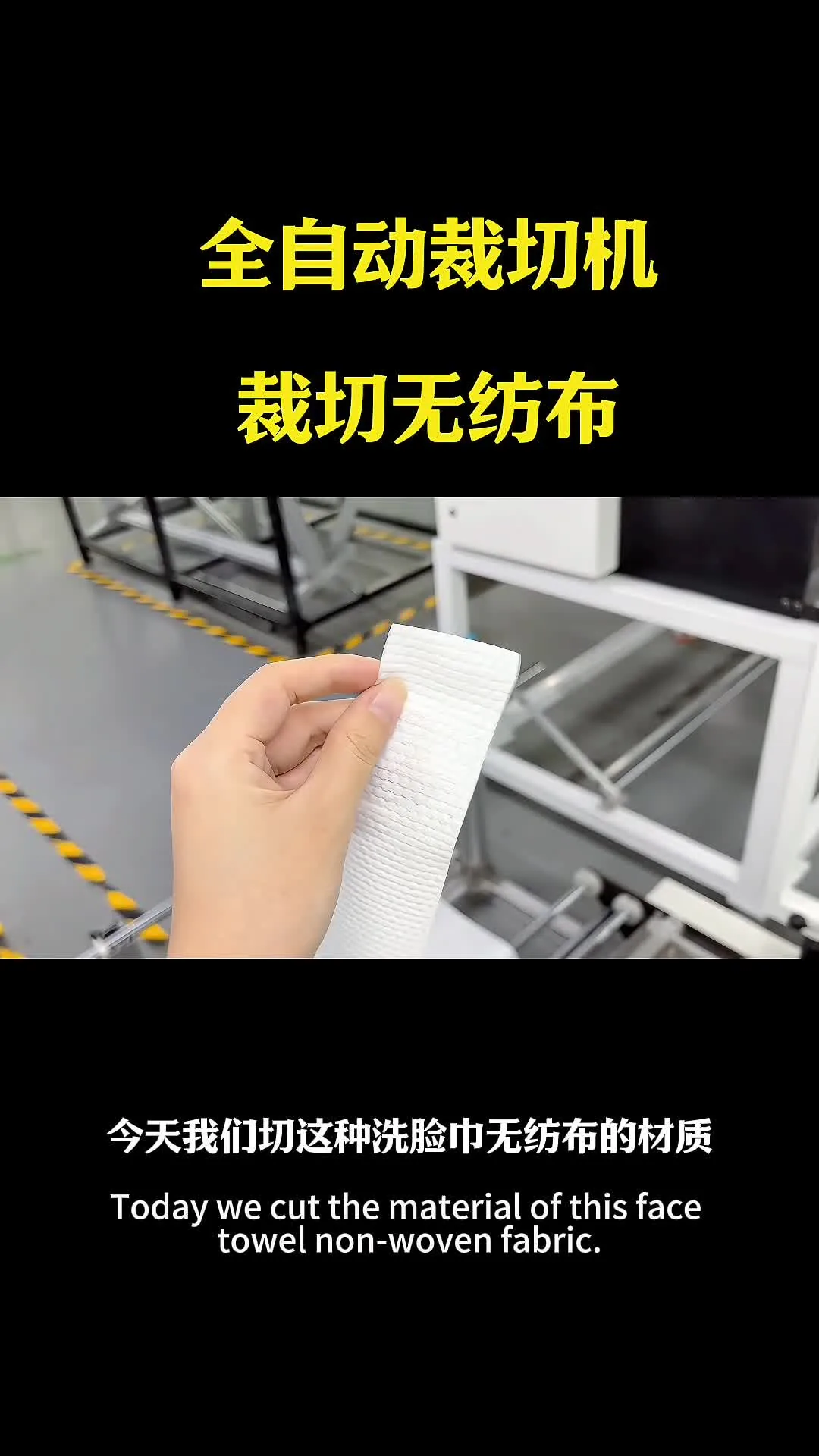
| Material | Face towel nonwoven with an embossed dot pattern | Embossing and softness affect how the roller grips the material |
| Weight | Described as “70 g” (70克) | The video does not state g/m²; confirm the basis weight with the material supplier. Weight is not thickness. |
| Cut length | Set to 100 mm | Your finished sheet length |
| Feed speed | Set to 40.0 mm/s on the panel | How fast the material is fed in this demo, not sheets per minute or a rated maximum |
| Quantity | Total set to 15 pieces | The number of sheets set for the run |
| First cut | Leading edge trimmed, counter reset to zero, then start | The uneven first piece is not counted |
| Result | Straight cut edges; sheets held against the panel scale lined up at 100 mm | A visual demo check, not a tolerance specification |
What “70 g” means for nonwoven
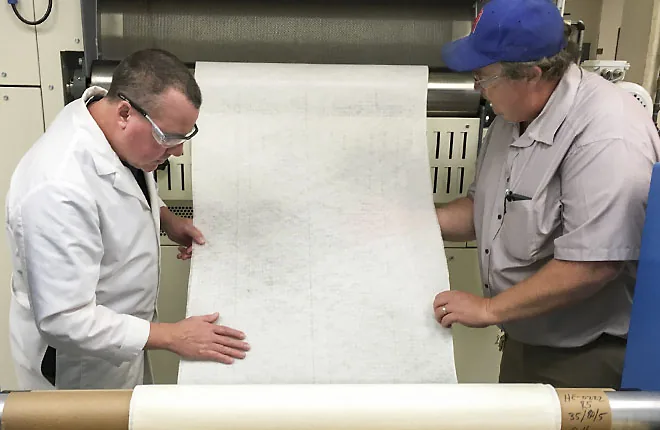
The video says the material is “70 g”. Nonwoven is normally sold by basis weight: grams per square metre, written g/m² or gsm. It tells you how heavy the fabric is, not how thick it is. Two nonwovens with the same weight can feel different if one is embossed or fluffier.
The video does not state the full g/m² unit, so “70 g” alone does not establish a verified 70 gsm specification for this sample. Confirm it against the material supplier’s data.
When you ask for a cutting trial, give both numbers: the weight in g/m² and the thickness. Also say whether the fabric stretches, because a soft, stretchy web can be pulled longer during feeding.
Step by step: cutting a nonwoven roll into sheets
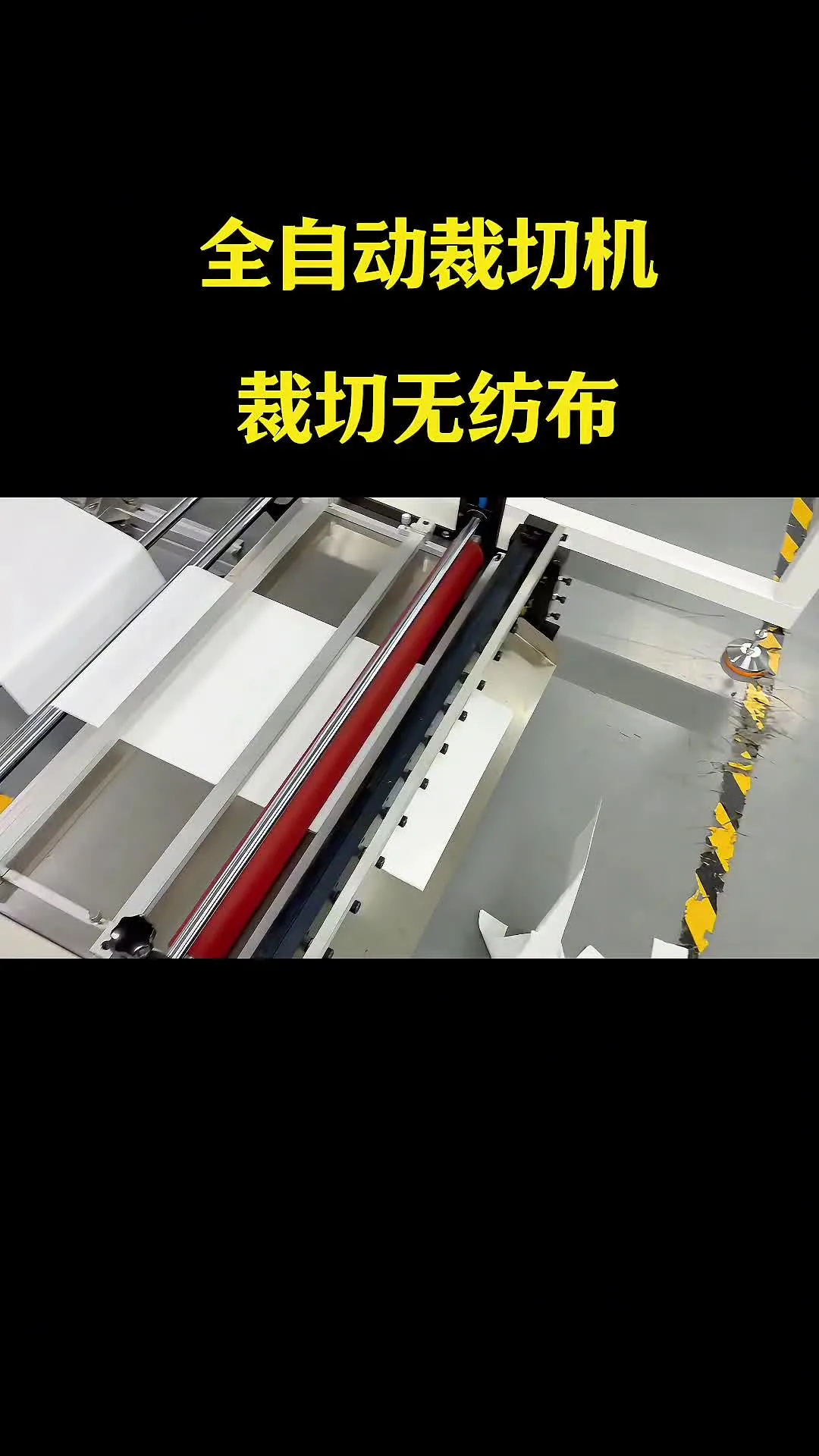
- Load and guide the roll. Put the roll on the unwind stand and guide the fabric straight into the feed roller. A crooked start gives crooked sheets.
- Set the cut length. In the demo, 100 mm was entered on the control panel.
- Set the feed speed. The demo set the feed speed to 40.0 mm/s. This is how fast the fabric moves forward, not how many sheets you get per minute. For soft or embossed material, choose a feed setting using the machine instructions and material trial; assess any increase only after dimensional and edge checks pass.
- Set the quantity. The demo set a total of 15 pieces for the run.
- Trim the first cut and reset to zero. If the leading edge is uneven or the starting position is unsuitable, cut it once first to get a clean starting edge. Resetting the counter means that trimmed piece is not counted.
- Start and check. Look at the cut edge, then measure the sheets. In the demo, the operator held sheets against the scale on the panel and they lined up with 100 mm.
What to check on the finished sheets
- Edge: straight and clean, with no pulled fibres.
- Length: measure sheets from the start, middle and end of the batch, and compare them with your required tolerance.
- Square: the cut should run straight across the width, not at an angle.
- Surface: the embossed pattern should not be flattened or marked by the feed roller.
- Count: the number of sheets should match the batch setting.
Which HESPER machine fits nonwoven sheets?
- Cut full-width sheets from the roll: Tabletop Automatic Roll to Sheet Cutting Machine offers automatic feeding, adjustable cut length and an LCD control panel with Chinese/English switching. Available cutting-width specifications are 300, 400, 500, 600, 700, 800, 1000, 1200, 1300, 1500, 1600 and 1800 mm. These are separate configurations, not one machine covering all widths. Confirm usable width and suitability for your nonwoven material with a sample trial.
- Slit the roll into narrower strips and cut them to length: see the fabric and nonwoven slitting and cross-cutting machine.
Blades can be customised by material and cut shape. If you need a shape other than a straight cut, send a drawing or sample so the blade and the machine setup can be assessed. For more on nonwoven, read nonwoven cutting for small batches and why nonwoven strip width changes.
What to send for a cutting trial
- Material type and a photo or sample of the roll
- Weight in g/m² and thickness
- Roll width, outside diameter and core size
- Finished sheet size and required length tolerance
- Any embossing, coating or print that must not be marked
- Sheets needed per day or per batch
- Whether you also need slitting into narrower widths
- Your power supply (voltage and frequency)
FAQ
Can a machine cut a nonwoven roll into face towel sheets?
Yes. A roll-to-sheet cutting machine feeds the nonwoven from the roll and cuts it across its width at a set length. Confirm suitability for your material, weight, width and finished size with a cutting trial.
What does 70 g mean for a nonwoven face towel?
Nonwoven is usually specified by basis weight in grams per square metre (g/m², often written gsm). It describes weight, not thickness. Send both the weight and the thickness when you ask for a trial. The video does not state the full g/m² unit, so “70 g” alone does not establish a verified 70 gsm specification for this sample. Confirm it against the material supplier’s data.
What does the 40.0 mm/s feed speed in the demo mean?
It is the feed speed set on that machine for the demo: how fast the fabric moves forward. It is not sheets per minute and not a rated maximum. Actual output depends on the cut length, the material and the settings, so measure it in a trial.
How accurate are the cut sheets?
In the demo, sheets cut at a 100 mm setting were held against the scale on the panel and lined up with 100 mm. That is a visual check, not a tolerance specification. State your required tolerance and measure several sheets from a trial run.
Cutting nonwoven into sheets? Send HESPER your roll details, weight, finished size and daily quantity. We will suggest a machine to test and discuss a cutting trial with your material. Send an enquiry or email sales@hespermachine.com.