
A supplier may show a perfectly set blade, yet the finished nonwoven strips still vary in width. For converters making wipes, packaging inserts or other nonwoven components, that variation can mean wasted material and unreliable downstream assembly.
The important question is not simply, “How accurate is the cutter?” It is, “Will my material stay within the agreed tolerance throughout a real production run?”
Here is a practical way to investigate that question before buying equipment.
1. Identify What Is Actually Changing
Different defects point to different areas of the process.
Every strip is consistently too narrow: Check the incoming usable web width, blade positions and whether the fabric changes width under feeding tension.
The left strip narrows while the right strip widens: Investigate sideways web movement, guide alignment and irregular parent-roll edges.
Widths drift after the machine speeds up: Look at unwind resistance, feed-roller traction and changes in web tension.
The width is acceptable, but edges are fuzzy or distorted: Examine blade condition, material construction and the cutting method.
These are diagnostic clues, not proof of a single cause. Lightweight spunbond and softer, loftier nonwovens may behave differently under the same feeding conditions.
2. Follow the Entire Roll-to-Part Process
For combined slitting and cross-cutting, the material path is:
Unwind → Guide → Feed → Slit Lengthwise → Cross-Cut to Length → Collect
Longitudinal slitting determines strip width; cross-cutting determines finished length.
A correct length setting cannot compensate for a web that wanders sideways before the slitting blades.
For the process basics, see HESPER’s Slitting and Cross-Cutting Guide.
Web handling also matters. Excessive tension can reduce the width of flexible materials while they are stretched, and uneven feeding can introduce wrinkles or lateral movement.
That is why a trial should use your actual material, rather than only a convenient demonstration roll.
3. Put Five Material Specifications in the Quotation
Before comparing machines, send the supplier the following information.
1. Material construction
Polymer or fibre type, bonding method, basis weight in gsm, thickness and compressibility.
2. Incoming roll
Nominal and measured web width, roll diameter, core size, roll weight and edge condition.
3. Finished strips
Number of lanes, required width of each lane, acceptable edge trim and smallest strip width.
4. Finished pieces
Cross-cut length, dimensional tolerances and acceptable edge appearance.
5. Production conditions
Target pieces per shift, batch changes, expected feed speed and how pieces will be collected.
Do not equate a catalogue model's width specification with guaranteed usable width.
Allow for edge trim and confirm the proposed cutting layout with the supplier.
4. Run a Sample Test That Reveals Width Drift
Request a trial with your production-grade nonwoven and an agreed written acceptance plan.
At the Start
Record the roll width and the intended blade layout.
Agree how and when finished pieces will be measured—for example, laid flat without deliberate stretching after a consistent rest period.
During the Run
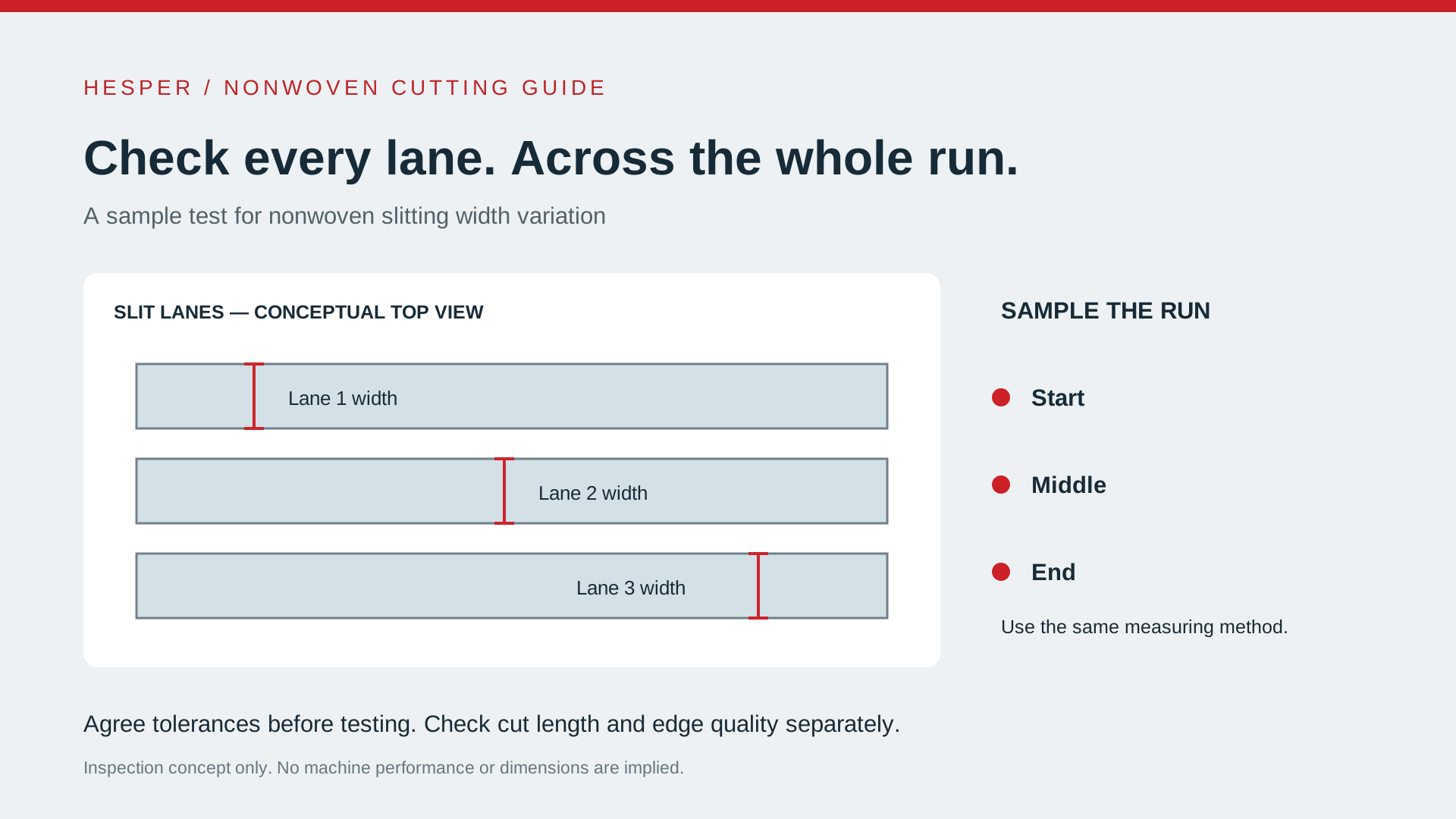
Take samples from the beginning, middle and end.
If production involves multiple speeds or different roll diameters, include those conditions.
Record the actual cutting speed rather than relying on a catalogue maximum.
On Every Sampled Piece
Measure every slit lane, not only the centre strip.
Check both sides for waviness, curled edges, lint or roller marks.
Verify cross-cut length separately.
After the Run
Report the maximum and minimum measured width, out-of-tolerance count and visible edge defects.
A useful figure is:
Nonconforming Rate = (Pieces Outside the Agreed Tolerance ÷ Pieces Inspected) × 100%
The buyer and supplier should agree on acceptance limits before the trial; no universal tolerance fits every nonwoven grade.
5. Match the Required Checks to Real Equipment
The HESPER Fabric & Nonwoven Slitting and Cross-Cutting Machine is listed for roll-fed longitudinal slitting and cross-cutting.
Its published configuration includes:
- SKD11 tooling.
- Rubber feed rollers with pressure adjustment at both ends.
- A bearing-supported floor roll stand.
- Variable-speed unwinding with photoelectric pre-feeding.
- Chinese/English LCD controls.
The model list includes the CXY-800T with an 800 mm width specification.
Usable width, minimum slit width, achievable tolerance and output still require confirmation using your material.
If your job requires only full-width sheets rather than multiple narrow strips, compare a dedicated HESPER Film & Nonwoven Cut-to-Length Machine instead.
Paying for longitudinal slitting is unnecessary when the finished width already matches the incoming roll.
Potential upgrades such as automatic edge guiding, closed-loop tension control, dedicated collection equipment or in-line inspection should be discussed as possible engineering requirements, not assumed standard features or confirmed options.
6. Ask These Questions Before Placing an Order
Can the supplier demonstrate all required slit widths and cut lengths using your specific nonwoven?
Does the trial include feed-speed changes and measurements from each lane?
What blade arrangement and changeover procedure are proposed?
What is the agreed usable width, and how will rejected pieces be counted?
A meaningful demonstration video should show the running material and measurements of the finished pieces, not just the control screen.
FAQ
Can cutting length be accurate while strip width is inconsistent?
Yes. Length control and lateral web position affect different dimensions. Check both independently.
Will a wider machine automatically improve strip-width accuracy?
No. Width capacity does not establish web stability, blade setup or achievable tolerance for your material.
Start With the Sample, Not the Catalogue
Send HESPER a sample roll or sample pieces, your slit-width layout, finished-length drawing, permitted tolerance and output requirement.
The team can review a suitable configuration and discuss a sample-cutting trial before you commit to a machine.