
Short answer
Start with the direction of the cut. To cut across a roll into sheets, you need a cross-cutting operation. To cut along the roll into narrower continuous strips, you need slitting. If both the finished width and length must change, you may need both operations. Some machines combine them, so describe the finished product before choosing the equipment.
“Cut it into 8-inch strips”: a real PVA film enquiry
A buyer in the United States enquired about a film cutting machine with these requirements:
- Material: PVA film, 80 µm thick (0.08 mm).
- Roll width: 12 inches.
- Requested result: cut it into 8-inch strips.
- Requested model: one CXY-300G.
These are the buyer’s requirements, not completed cutting-test results. “8-inch strips” could refer to the length of each piece or the width of a continuous strip. Before recommending a configuration, we asked which result was intended.
Slitting machine vs cross cutting machine
| Cross cutting | Slitting | |
|---|---|---|
| Cut direction | Across the full web width | Along the web’s travel direction |
| Typical output | Separate sheets or pieces | Narrower continuous strips; rewinding depends on the machine |
| Main dimension to specify | Length between cuts, plus the incoming web width | Width of each strip |
| Related terms | Roll-to-sheet cutter; cut-to-length machine | Film slitting machine; slitter rewinder when rewinding is included |
| Nominal result in this example | 12 × 8 in pieces | One 8 in strip and approximately 4 in remaining width, before edge trim or cutting loss |
If the buyer wants pieces that retain the original 12-inch width and are 8 inches long, the task is roll-to-sheet cross cutting. If the buyer wants an 8-inch-wide continuous strip, the task is slitting; rewinding must also be specified if the output needs to be a narrower roll.
Slitting a nominal 12-inch web into an 8-inch strip leaves about 4 inches of width before trim or cutting loss. That remainder may be usable or may become waste. Consider whether buying the required incoming width would avoid an unnecessary operation.
Check the width in millimeters, not just the model name
One inch is exactly 25.4 mm. Convert the roll width before comparing it with the machine’s confirmed working width.
| Width in inches | Width in millimeters |
|---|---|
| 8 in | 203.2 mm |
| 10 in | 254.0 mm |
| 12 in | 304.8 mm |
| 16 in | 406.4 mm |
| 20 in | 508.0 mm |
| 24 in | 609.6 mm |
A 12-inch roll is 304.8 mm wide, which exceeds a true 300 mm limit. For the CXY-300G in this enquiry, the factory stated a usable width of 310 mm and said the roll could be loaded. The nominal difference is 5.2 mm in total, or 2.6 mm per side only if the web is centered.
This is a width check, not proof that the actual PVA film will feed and cut correctly. Confirm the roll’s measured width and variation, edge condition, guiding space and usable feed-and-cut width for the offered configuration. Also check roll diameter, weight and core dimensions; the model name alone does not settle those questions.
The CXY-300G information supplied for this enquiry
The machine discussed here is offered for feeding roll material and cross-cutting it at a selected length. This operation makes pieces; it does not by itself produce narrower rewound rolls.
Related product: Film & Nonwoven Cut-to-Length Machine. See the product page for the model range and machine configuration.
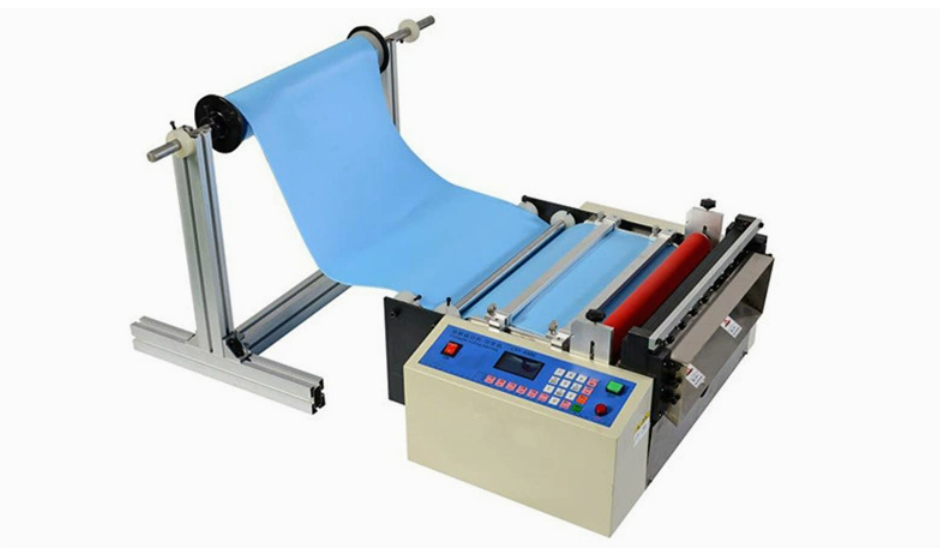
| Item | Supplied CXY-300G information |
|---|---|
| Cutting width | 310 mm, confirmed by the factory for the CXY-300G in this enquiry |
| Listed cutting tolerance | 0.002 × L mm, where L is cut length in mm |
| Listed feeding accuracy | 0.01 mm |
| Power supply | 110–120 V, 60 Hz |
| Feed motor | Stepper motor |
| Blade grade | SKD11 tool steel |
| Roller pressure | Adjustable |
| Display | Chinese / English LCD |
| Listed machine weight | 52 kg |
| Listed dimensions | 580 × 580 × 400 mm |
Source: the supplied CXY-300G specification sheet and confirmed configuration details for this enquiry. Values are listed specifications.
At L = 203.2 mm (8 inches), the stated expression 0.002 × L gives 0.4064 mm, approximately 0.41 mm. This calculation illustrates the listed formula.
The separate 0.01 mm entry is labelled feeding accuracy in the source. Feeding accuracy, setting resolution and finished-cut tolerance describe different things. Evaluate the finished-piece dimensions through a representative sample test.
Daido Steel classifies SKD11 as cold-work tool steel. Blade selection should take the film and required edge finish into account.
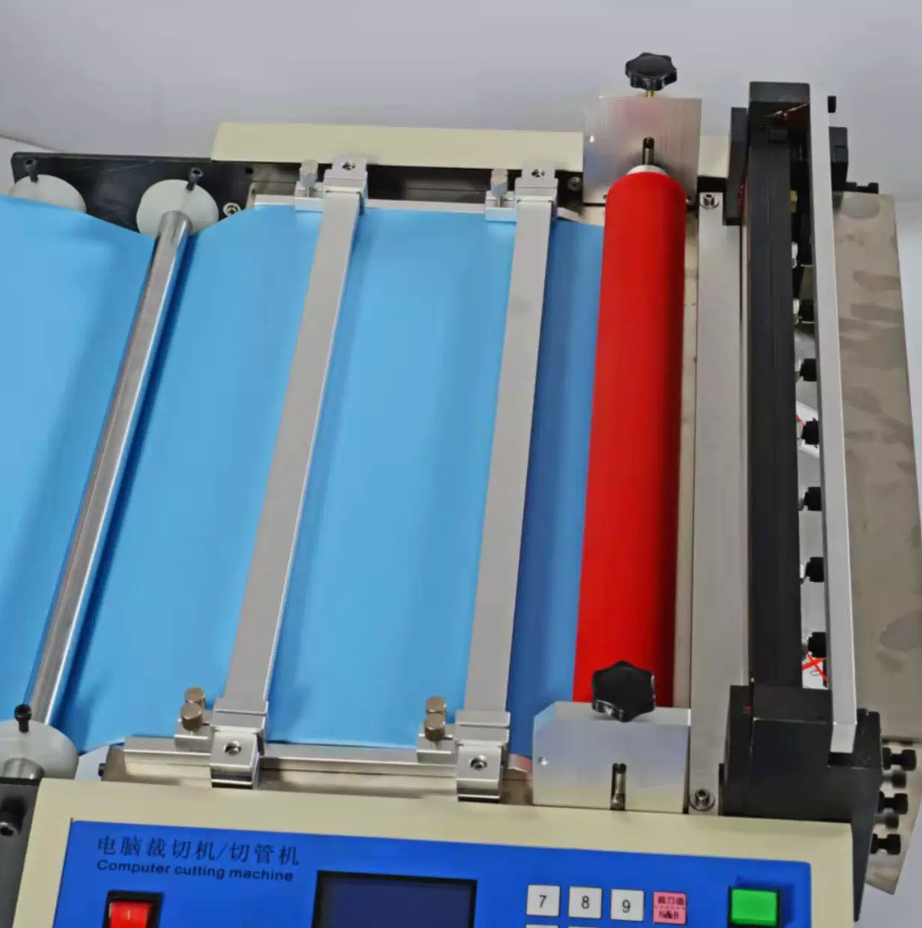
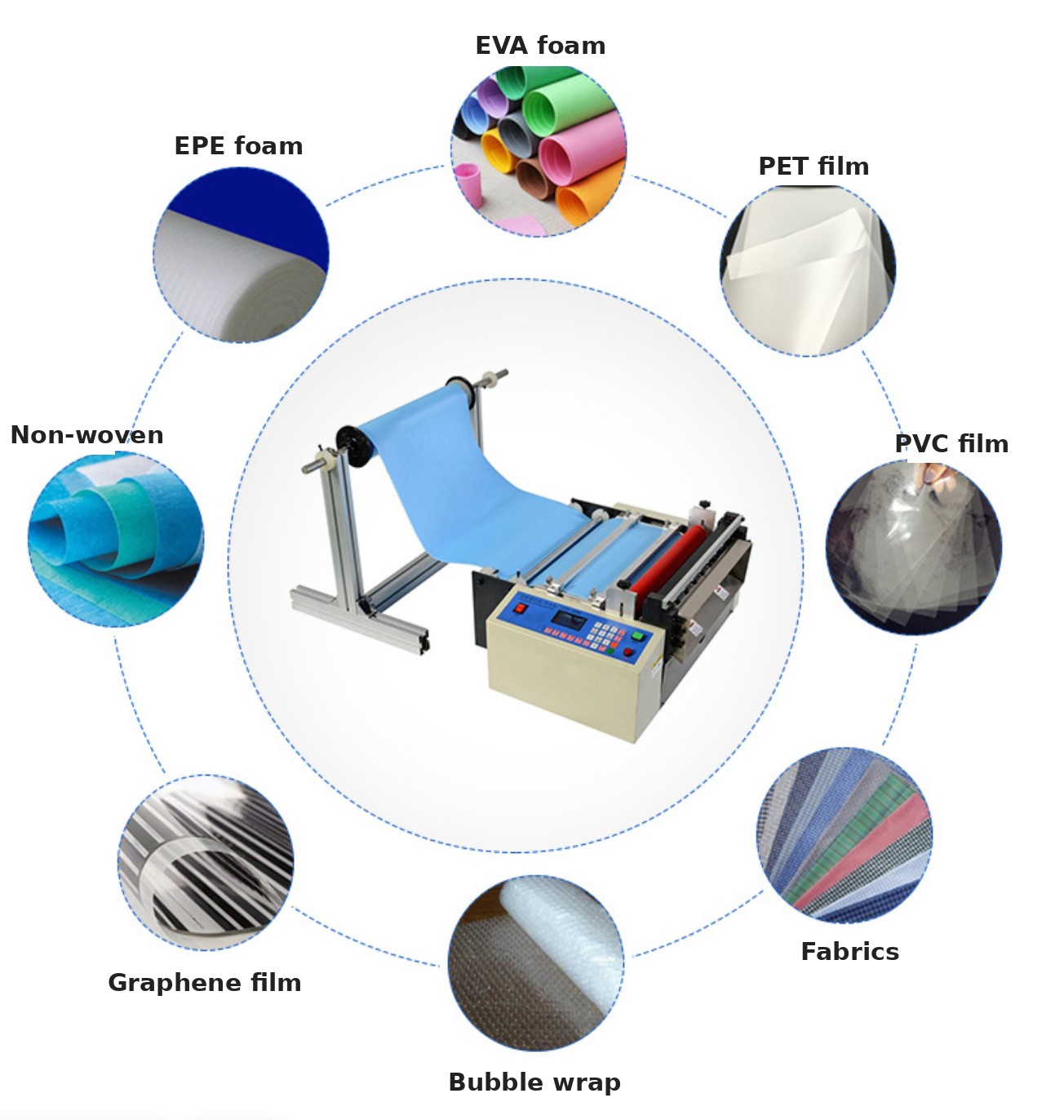
For the roll-handling details to include in an enquiry, see Your Fabric Roll Fits. But Will It Feed? and How to Specify an Unwind Roll for a Cut-to-Length Machine.
What to tell the supplier about your PVA film
The name “PVA film” does not identify the complete material specification. PVA is also commonly called PVOH. Its response to water and humidity varies with the formulation and processing; Kuraray’s technical reference explains how film properties depend on grade and moisture conditions. That general reference does not establish the behavior of this buyer’s 80 µm film.
- Grade and water response: supply the film maker’s grade or data sheet, and state whether it is a water-soluble film and what storage or handling conditions are specified.
- Layer structure: state whether it is a single layer or has a liner, coating or adhesive side.
- Thickness and handling: provide the thickness range and any observed stretching, wrinkles, static or sticking during handling.
- Finished result: specify dimensions, allowable variation, edge quality and required output.
Ask whether a representative sample test can be arranged. Agree the test conditions and how feeding, cut edges, finished dimensions and repeated operation will be evaluated.
Check the exact workshop power supply
The CXY-300G configuration discussed here supports 110–120 V, 60 Hz. Give the supplier your actual workshop power supply and plug or connection requirements, and include the electrical configuration in the quotation and order specifications.
Your quote checklist for a film cutting machine
Include these details to make the enquiry easier to evaluate:
- Cut direction: cross cutting, slitting, or both.
- Finished format: sheets or rolls; width × length for sheets, each strip width and rewinding requirements for rolls.
- Material: grade, thickness range, layer structure, water response and handling conditions.
- Incoming roll: measured width and variation, outside diameter, weight and core inside diameter.
- Acceptance criteria: permitted dimension variation, measurement conditions and edge requirements.
- Output: pieces per hour/day or the required roll-processing rate.
- Power: voltage, frequency, phase and connection.
- Photos or drawing: the roll and a simple sketch of the required finished product.
FAQ
What is the difference between a slitting machine and a cross cutting machine?
Slitting divides a web along its travel direction into narrower strips. Cross cutting cuts across the web at a selected length. Some equipment combines both operations; specify the finished width, length and whether the output should be sheets or rolls.
Is a sheet cutter the same as a cross cutting machine?
Not always. A roll-to-sheet cutter normally feeds a roll and cross-cuts it into sheets, but “sheet cutter” can also mean equipment that starts with individual sheets. Check the feed format and actual cutting operations.
What is a film slitting machine used for?
It divides a wide film web into narrower continuous strips. If you need the strips supplied as rolls, confirm that the machine includes suitable rewinding. A separate cross-cutting operation is needed for finite-length pieces unless the line combines both processes.
Can I cut 12-inch film on a 300 mm machine?
A 12-inch roll is 304.8 mm wide, so it exceeds a true 300 mm maximum. For the CXY-300G discussed here, the factory stated a usable width of 310 mm and said the roll could be loaded. Confirm the actual roll width, guiding and usable feed-and-cut width for the offered configuration.
Does 0.01 mm feeding accuracy guarantee 0.01 mm finished pieces?
No. The supplied CXY-300G sheet lists feeding accuracy and cutting tolerance separately. Evaluate finished-piece accuracy through a representative sample test.
Is PVA film hard to cut?
That depends on the actual film and setup. Provide thickness, grade, moisture sensitivity, any liner or adhesive, and the required dimensions. Ask whether representative sample testing can be arranged to check feeding, edges and finished dimensions.
Will the CXY-300G run on my workshop power supply?
The CXY-300G configuration discussed here supports 110–120 V, 60 Hz. Include your workshop power supply and connection requirements when requesting a quotation.
Discuss your cutting requirement
Send HESPER the checklist details, a roll photo and a sketch of the finished product. We can discuss the required cutting process, which configuration needs checking and whether representative sample testing can be arranged.
Send an enquiry or email sales@hespermachine.com.