
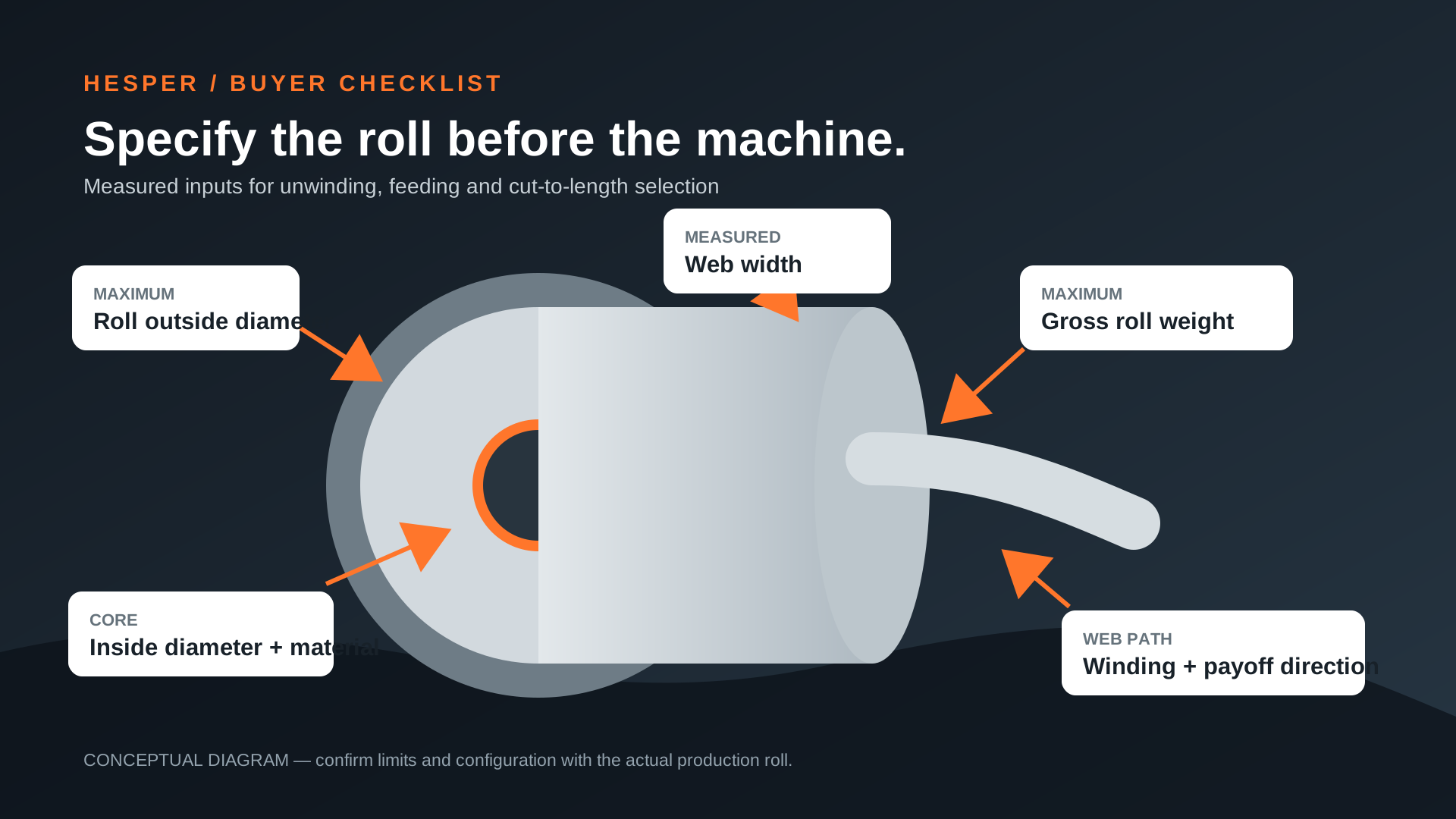
“The roll is 800 mm wide” is not enough information for an automatic cut-to-length machine quotation. Two rolls with the same width can require different supports, shafts and unwinding control because their outside diameter, core, weight and material behavior are different.
A complete input-roll specification helps the supplier check loading, unwinding and feeding before discussing cutting speed or finished length.
1. Why Roll Width Alone Is Not Enough
The unwind section has to carry the roll and release material into the feed system. As the roll becomes smaller, its rotational behavior changes. Flexible webs may also stretch, wrinkle or drift if the material is released irregularly.
That means a model width is only one selection value. It does not confirm the permitted roll diameter, roll weight, shaft fit or achievable tension for your material.
If your finished parts are full-width sheets, start with a cross-cutting process. If one wide roll must first become several narrow lanes, you need longitudinal slitting as well. The difference is explained in HESPER’s slitting and cross-cutting guide.
2. Record Seven Input-Roll Details
Put these values in the request for quotation. Use measured production rolls where possible.
| Input | What to provide | Why it matters |
|---|---|---|
| Material | Composition, thickness or basis weight, layers and surface condition | Helps assess stretch, friction, compression and cutting method |
| Web width | Nominal width and maximum measured width | Used to check the material path and required working width |
| Roll outside diameter | Maximum full-roll OD | Affects stand clearance, rotational inertia and loading space |
| Core inside diameter | Measured ID and core material | Used to match the shaft or core-support arrangement |
| Roll weight | Maximum gross weight | Required for stand, shaft and loading assessment |
| Winding direction | Which face is outside and whether the web pays off over or under the roll | Determines the required web path and product orientation |
| Roll quality | Edge condition, telescoping, splices and variation between batches | Reveals feeding risks that a perfect sample roll may hide |
Also state whether the material stretches easily and whether roller marks, folds or surface contact are restricted. A photo of the roll beside a ruler is useful, but it should support—not replace—the measurements.
3. Connect the Roll to the Whole Process
For automatic cross-cutting, the practical route is:
Load roll → Unwind → Guide → Feed → Cut to length → Collect
Each step needs its own acceptance question. Can the roll be loaded safely? Does it release material smoothly? Does the web stay aligned? Do the feed rollers move the material without slipping or marking it? Does the finished piece meet the agreed length and edge requirements?
The HESPER Mesh & Fabric Cut-to-Length Machine combines unwinding, feeding and cross-cutting. Its published configuration includes a bearing-supported floor roll stand, photoelectric automatic unwinding, variable-speed adjustment and rubber feed rollers with pressure adjustment at both ends.
The product page lists a standard 800 integrated cutter and 220 V supply. It does not publish a universal maximum roll OD, core ID or roll weight, so those values must be confirmed against the customer’s actual roll.
4. Turn the Data Into Machine Requirements
After the roll data is known, the supplier can review the support and control arrangement. Possible engineering requirements may include a different shaft or core adapter, assisted roll loading, braking or tension control, an edge-guiding system, or a revised collection method.
These should not be assumed to be standard HESPER options. Ask the supplier to identify what is standard, what must be adapted and what evidence will be used to approve the proposal.
For a wider process brief—including finished dimensions, tolerance and target output—use the roll-material enquiry checklist.
5. Verify With Your Production Roll
Before ordering, request a sample trial using the same material grade, roll build and core used in production. Agree on the test before the machine runs.
- Record the starting roll diameter and actual web width.
- Run at the proposed normal speed, not only a brief slow demonstration.
- Observe unwinding near the full roll and again at a smaller diameter.
- Inspect tracking, wrinkles, feed marks and cut-length consistency.
- Repeat the test after a stop and restart.
A video should show the roll, complete material path and measured finished pieces. A control-screen close-up alone cannot prove that the roll feeds reliably.
FAQ
Is roll width the same as usable cutting width?
Not necessarily. Machine layout, edge clearance and the proposed cutting process must be reviewed. Confirm usable width in writing for your material.
Why does roll diameter matter if the web width is unchanged?
A larger roll needs more clearance and has different rotational inertia. Unwind behavior also changes as the diameter decreases during production.
Should I request closed-loop tension control?
Only after defining the material and process problem. Some applications may work with simpler automatic unwinding; sensitive or stretchable webs may require a more specific tension solution. Treat it as an engineering requirement to evaluate, not a default feature.
Send a Complete Roll Brief
Send HESPER the seven roll details, material photos, finished-part drawing, allowed tolerance and target output. The team can review the material path and confirm which machine configuration should be tested before purchase.