
BUYING A MACHINE · SHIPPING & POWER
The machine can be ready long before it reaches you. Most of the wait is the trip, and the first surprise on arrival is often the power supply. Here is how to plan for both before you order.
A buyer in the United States ordered an automatic mesh cutting machine. It took three and a half months to arrive. In a five-star review, the buyer explained that production was not the slow part. Shipping was: the cargo was moved to a new shared container on the way, and it cleared customs at two ports. Questions were answered quickly throughout. The machine arrived well packed, the interface was easy to use, and it met the buyer's expectations for the job.
One more detail stands out. The machine ran on 220 V, and the buyer used a converter to power it from standard 120 V US outlets. That is a happy ending, but it shows the two things worth settling before you order: how long the whole delivery will take, and whether the machine matches your power supply.
THE SHORT ANSWER
Ask for the production time and the shipping time as two separate figures, and add a buffer for transshipment and customs. Agree on the shipping terms, so you know who handles freight, customs and delivery. Before the machine is built, confirm the voltage and frequency it will be wired for. If it runs on 220 V and your outlets supply 120 V, you need a step-up transformer rated above the machine's power, not just a plug adapter. Ask for the crate size and packed weight for your freight quote, and check that the control panel is in a language your operators read.
- 01 Where the time goes
- 02 Plan the lead time
- 03 Voltage and frequency
- 04 Packing and arrival
- 05 Interface and support
- 06 Before you order
- → HESPER machines
- ? FAQ
01 · WHERE THE TIME GOES
Production is only part of the wait
When buyers ask "how long will it take?", the answer usually covers the factory. The machine then has to be crated, booked onto a vessel, shipped, cleared and delivered. Each step adds time, and some of it is out of everyone's hands.
| What happened | Why it adds time | What to ask before ordering |
|---|---|---|
| Cargo moved to a new shared container | A small shipment shares a container (LCL) and may be transferred between vessels or containers | Is there a direct route? Is a full container (FCL) worth it for the volume? |
| Customs at two ports | Each transshipment or entry point can mean another inspection or release | Which port will it enter? Who is the customs broker? |
| 3.5 months door to door | Production, booking, transit, clearance and local delivery add up | Production time and shipping time, quoted separately |
| Fast replies from the seller | Kept the buyer informed while the shipment was moving | Who will update you, and how? |
02 · PLAN THE LEAD TIME
Get two numbers, not one
- Production time. How long until the machine is built, tested and packed.
- Shipping time. How long from leaving the factory to arriving at your site, including customs and local delivery.
- Shipping terms. Agree the Incoterms up front. Under FOB or CIF you arrange part of the journey and the customs clearance yourself, usually through a freight forwarder or customs broker. Under DDP the seller arranges delivery to your door, duties included.
- Route. Ask whether the shipment will be transshipped, and whether a direct sailing is available for your port.
- A buffer. Port congestion and customs inspections are hard to predict. If the machine is needed for a contract, plan around the longer estimate.
03 · VOLTAGE AND FREQUENCY
Match the machine to your power supply
Mains power is not the same everywhere. The US runs at 120 V and 60 Hz. Most of Europe and much of Southeast Asia run at 220–240 V and 50 Hz, and some countries, such as the Philippines, use 220 V at 60 Hz. A machine built for one supply may need a change before it can run on another.
- Say where it will run. Tell the supplier the country and the supply at your site before the machine is built.
- Ask what it will be wired for. Some machines can be supplied for 110 V or 220 V. Others are listed for 220 V only.
- Check the frequency. Motors can behave differently at 50 Hz and 60 Hz, so confirm the machine suits yours.
- Know the difference between an adapter and a transformer. A plug adapter only changes the shape of the plug. To run a 220 V machine from 120 V, you need a step-up transformer that raises the voltage.
- Size the transformer properly. Choose one rated comfortably above the machine's nameplate power, and ask the supplier for a recommendation.
- Check the nameplate on arrival. Compare it with your supply before you connect anything.
04 · PACKING AND ARRIVAL
A good crate saves a bad day
A machine may be handled several times on the way, especially if it changes containers. Sturdy export packing is what gets it to you intact.
- Ask how it is packed. An export wooden crate is common for machines like these.
- Get the crate size and packed weight. Your forwarder needs them to quote freight and plan unloading.
- Inspect before you sign. Check the crate for damage when it is delivered, and photograph anything unusual.
- Keep the paperwork together. Invoice, packing list and shipping documents make clearance smoother.
05 · INTERFACE AND SUPPORT
The first run should be easy
The buyer in the review called the interface very intuitive. That matters when the machine arrives and nobody from the factory is on site.
- Check the panel language. Ask whether the control panel can display English, or the language your operators use.
- Ask for a test video. A short video of the machine cutting your material before it ships shows it is set up for your job.
- Agree how support works. Fast replies were part of what made a long delivery acceptable in the review. Know who to contact and how.
06 · BEFORE YOU ORDER
A short checklist
- Material. What you cut, its width and thickness. For wire mesh, the wire diameter and aperture.
- Power. Your country, voltage and frequency.
- Timing. Production time and shipping time, quoted separately.
- Terms. Incoterms, destination port and who handles customs.
- Packing. Crate size and packed weight.
- Panel and support. Interface language, and who answers when you have a question.
HESPER EQUIPMENT
HESPER cut-to-length machines
Power supply is listed differently by model, so confirm voltage and frequency for your site when you enquire. Lead time, shipping and warranty are confirmed in the quotation.
THIN METAL & WIRE MESH
CXY-100 seriesCut-to-length for thin metal sheets, copper and aluminum sheets and steel wire mesh. Cutting width 100 mm. Listed power supply 220 V / 50 Hz. The CXY-100H has an LCD with a Chinese / English interface. See the CXY-100 seriesROLL TO SHEET
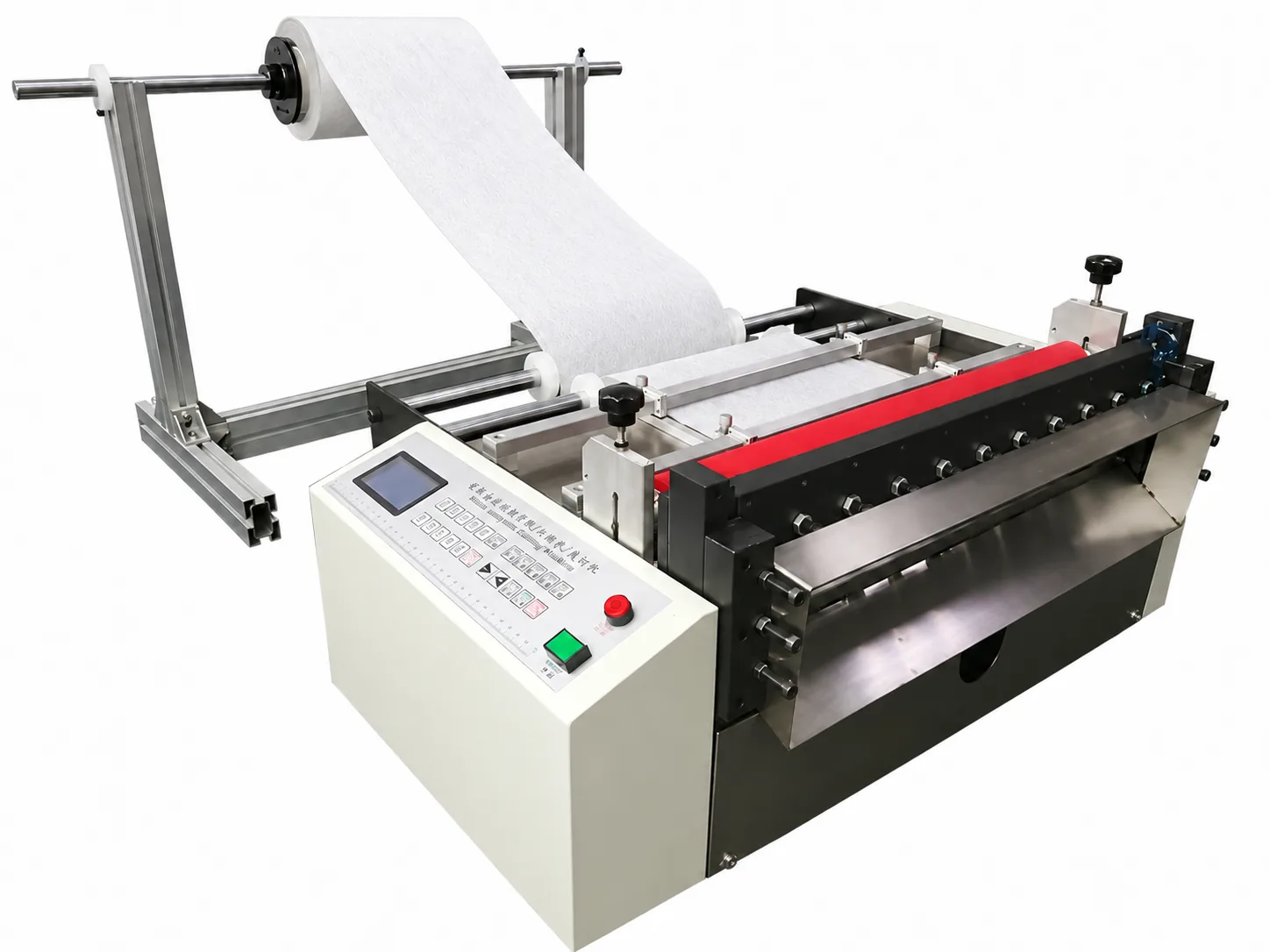
HYD-400 tabletopRoll-to-sheet cutting in widths from 300 to 1800 mm. Power supply configurable to customer requirements. LCD panel switchable between Chinese and English. See roll-to-sheet machinesTAPE & WEBBING
Hot and cold tape cuttersFour options, cutting widths up to 310 mm. All four list 110 V / 220 V options. See the tape cutters? FAQ
Importing a cutting machine: questions
How long does it take to receive a machine from China?
It depends on production time, the shipping route and customs. In one US buyer's review the total was 3.5 months, mostly in transit. Ask for production and shipping times separately.
Why does shipping take so long?
Smaller shipments often share a container and may be transferred on the way. Each transfer or port of entry can add handling and customs time.
Can I use a 220 V machine in the US?
Yes, with a step-up transformer that converts 120 V to 220 V and is rated above the machine's power. Or ask whether the machine can be supplied for your voltage.
Is a plug adapter enough?
No. A plug adapter only changes the plug shape. It does not change the voltage.
Does 50 Hz or 60 Hz matter?
It can, because motors can behave differently on each. Confirm the machine suits your frequency.
What shipping terms should I choose?
It depends on how much of the process you want to handle. Under DDP the seller arranges delivery and duties. Under FOB or CIF you or your forwarder take over part of the journey and the customs clearance.
What should I check when the machine arrives?
The crate for damage, the nameplate against your power supply, and a first test cut on your own material.
BUYING
Planning an Order From Overseas?
Tell HESPER what you cut, your country and power supply, and your destination port. Ask us to confirm the voltage and frequency the machine will be supplied for, and to quote production and shipping time separately.
Send an enquiry · See all machines · sales@hespermachine.com