
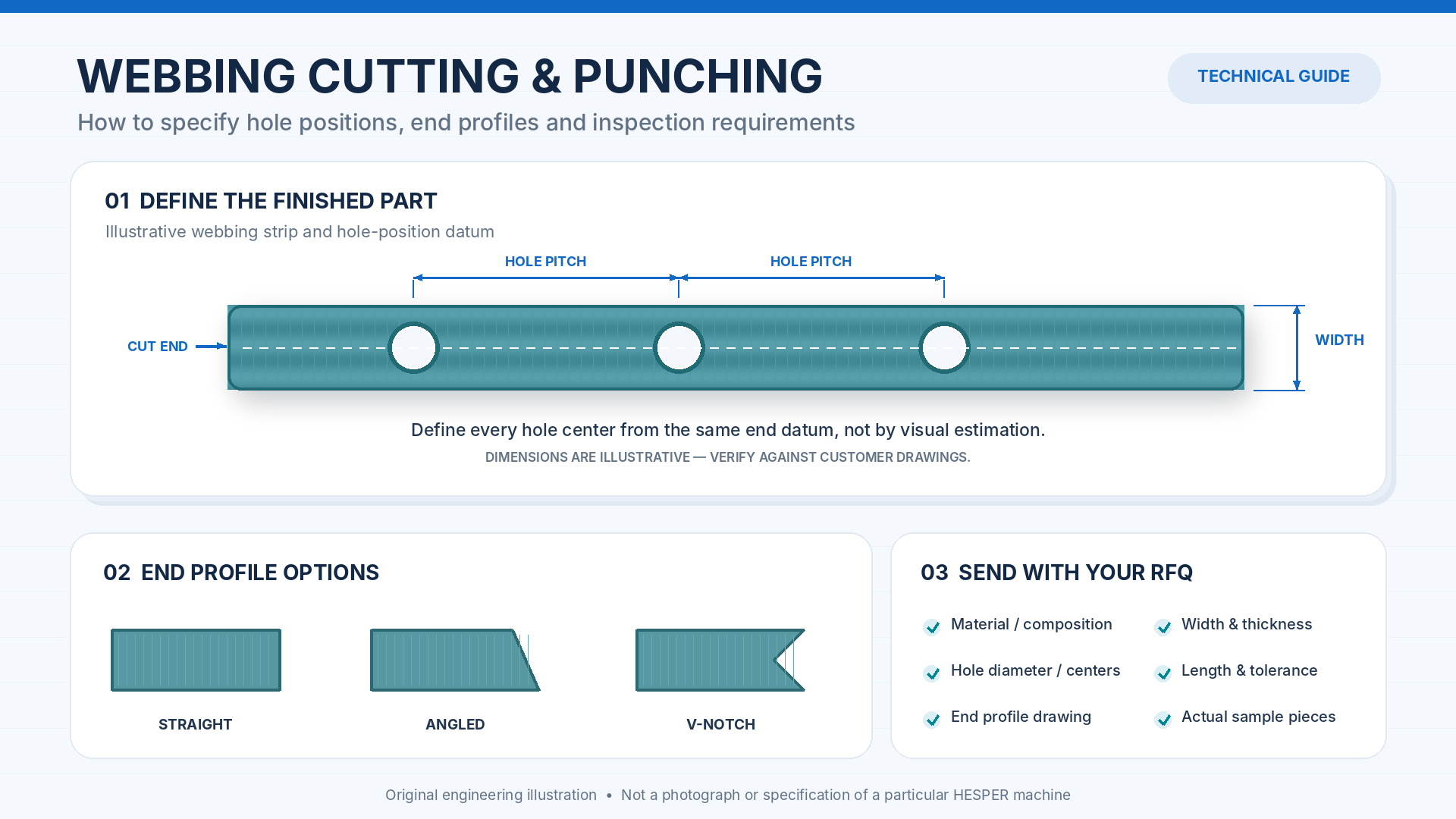
When buying a webbing cutting and punching machine, the finished strap matters more than a headline speed figure. A strap can have the correct overall length and still fail assembly because its holes are offset, the end profile is wrong, or the material stretches during feeding.
A clear drawing and a representative sample help machine suppliers understand the job before discussing tooling, output or price. Here is what to specify for ribbon, belting, bag-handle straps and similar narrow materials.
1. Define the Material Before the Cutting Method
Start with the webbing composition, construction, width, thickness and number of layers. State whether the strip is stiff, elastic, coated or printed. If the finished component will be folded, sewn or attached to hardware, explain that use as well.
These details influence feeding, holding and edge-finish requirements. A machine should not be selected solely because a material appears on a general application list. Ask for a trial using the actual production sample, especially when the material contains blended fibers or stretches under tension.
2. Dimension Every Hole from a Consistent Reference
A note such as “three evenly spaced holes” is not enough for production. Your drawing should identify:
- Overall cut length and finished strip width.
- Hole diameter or shape and the required quantity.
- Distance from the cut end to the first hole center.
- Center-to-center spacing between successive holes.
- Hole centerline position across the strip width.
- Permitted position and size tolerances.
Use a clearly marked datum, such as the left finished end, and keep the dimensioning method consistent. For a symmetric hole pattern, specify symmetry explicitly rather than assuming the operator will infer it. If the strip stretches, state whether dimensions must be checked relaxed or under a defined measuring condition.
3. Treat End Profiles as Tooling Requirements
Straight, angled and V-notched ends can require different cutting tools. Changing a touchscreen setting does not necessarily change the physical cut geometry.
Provide a dimensioned sketch of the desired end profile. Include the angle, notch depth or profile radius where relevant. If appearance matters, provide photos of both acceptable and unacceptable cut edges.
HESPER's CXY-80T ultrasonic webbing cutting and punching machine lists programmable hole count and spacing, plus angled and V-cut options that depend on the selected tooling. Final compatibility must be checked against the material and drawing.
4. Confirm Whether Ultrasonic Cutting Fits the Material
Ultrasonic cut-and-seal processing can be useful for suitable thermoplastic textile materials because cutting and edge sealing may occur together. That does not mean every fabric, coating or mixed-fiber webbing will seal in the same way.
Ask the supplier to inspect the cut edge after a sample trial. Check for fraying, stiffness, discoloration, deformation and any effect on the strap's intended use. If an ultrasonic process is not required, a different cutting-and-punching configuration may be more appropriate.
HESPER also lists a webbing and handle-cord cutting and punching machine. Compare configurations on material suitability, tooling and the required finished result rather than assuming one process is best for every strap.
5. Approve a Sample Before Full Production
For a new part, request several consecutive sample pieces rather than judging only one. Measure overall length, hole-center positions and end profiles with an agreed method. Check that holes remain usable after fitting the intended fastener or hardware.
Record any relevant feed setting and material condition used for the successful sample. A repeat order is easier to prepare when the previous acceptance criteria are documented.
6. Send a Complete RFQ Package
A practical request for quotation should include a material sample, composition, width and thickness, a dimensioned part drawing, cut length, hole pattern, end profile, required tolerance, batch quantity and target output. Include available power and compressed-air conditions where applicable.
Ask the supplier to confirm tooling requirements, sample-trial results, realistic cycle output and what adjustments are needed when changing to another strap size. These answers are more useful than comparing maximum speed figures without a material test.
Frequently Asked Questions
Can hole spacing be changed on a cutting and punching machine?
On the CXY-80T, hole count and spacing are listed as programmable settings. However, the achievable pattern, dimensions and tolerances still depend on tooling and the actual material. Confirm the required layout before ordering.
Does ultrasonic cutting seal every type of webbing?
No. The result depends on fiber composition, construction and process settings. Test the actual webbing and inspect the finished edge.
What is the most useful file to send with an enquiry?
A dimensioned part drawing accompanied by a physical sample is ideal. If a formal drawing is unavailable, a marked-up photo with all hole centers, finished dimensions and tolerances is a useful starting point.
Discuss Your Webbing Cutting Project with HESPER
Need to cut webbing to length and punch holes in the same production process? Send HESPER your material sample, hole-position drawing, desired end profile and target batch size. The team can review which machine configuration and tooling should be evaluated for your parts. Contact HESPER about your cutting requirements.