
A wallpaper sample lets a customer see the color and feel the texture before choosing a design. Making a few is straightforward: unroll the material, measure it and cut along the line. When the same design needs regular replenishment, or several collections need sample-book blanks, measuring, cutting and counting become recurring work.
An automatic roll-to-sheet wallpaper cutter takes on the feeding, fixed-length cross-cutting and counting. For shops and workshops preparing repeat samples, its value lies in removing the need to start with a ruler for every piece.
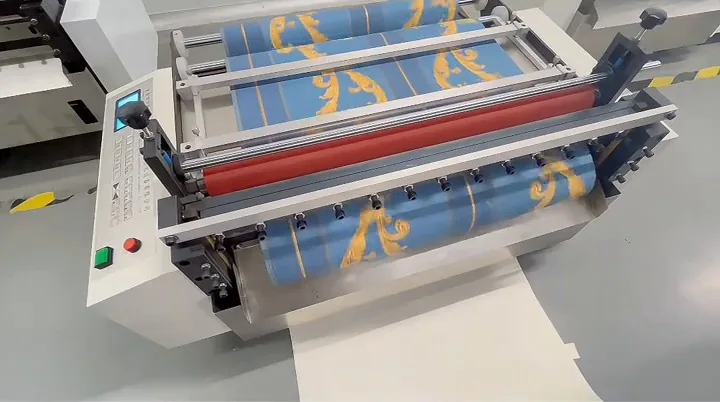
From a wallpaper roll to a stack of sample blanks
In this demonstration, blue-and-gold patterned wallpaper travels from the roll holder through the guides and feed rollers to the cross-cutting blade. After trimming the leading edge, the operator runs repeated cuts at the selected setting. The continuous roll becomes individual pieces at the outfeed.
The source video describes the equipment as a 600 mm tabletop cutter. The length is set to 420 mm for this run: it demonstrates repeated cuts at one setting, while finished dimensions still need measuring. The displayed speed value of 20 is a control level, not 20 meters per minute or 20 pieces per minute.
Watch the wallpaper cutting demonstration
 ▶ Watch on YouTube
View product: Tabletop Automatic Roll to Sheet Cutting Machine
For someone preparing sample books, the practical difference is easy to see. Once the first pieces are suitable, the same setting can be used for the following cuts instead of measuring each piece again. Material handling and inspection remain part of the job, but repetitive measuring and cutting no longer have to take up all of the operator’s attention.
Useful wallpaper samples need more than the right length
The sample is ultimately something a customer will look at. A piece may have the intended length yet cut through the motif that the sample book needs to show. Deciding how to cut wallpaper into useful samples therefore starts with how much of the pattern the customer should see.
Full-width cross-cutting controls the length along the feed direction; the other dimension normally remains the roll width. Narrower blanks need further trimming or a separately confirmed optional slitting arrangement. If every sample must start at the same point in the pattern, registration needs separate consideration: a fixed length setting alone does not provide automatic pattern matching.
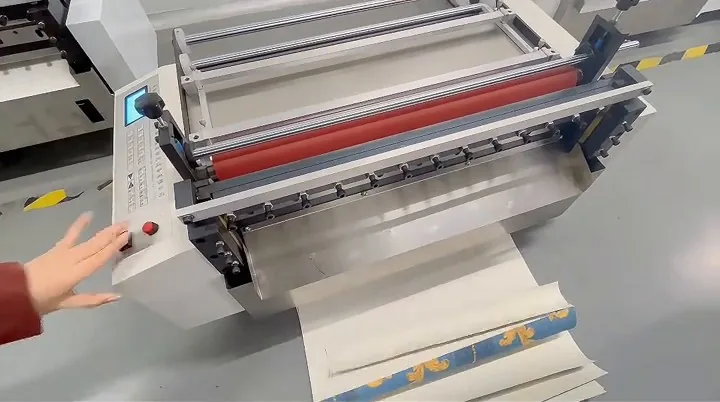
This is why a few trial pieces can tell you more than a specification table alone. Place them in the sample book you actually use, look at the dimensions, pattern position and edges, and check the face for pressure marks or scratches. That gives you a practical basis for deciding whether the process suits your product.
A different wallpaper deserves another trial
Wallpaper constructions can differ substantially. Thickness, embossing, backing and curl affect how the material behaves through feed rollers. Adhesive-backed materials and release liners also need their feeding and cutting requirements checked against the actual construction.
The HESPER Tabletop Automatic Roll to Sheet Cutting Machine lists paper, card, PVC film and laminates among its applications. For a particular wallpaper, trial-cutting the actual roll brings the face, backing and cut edge into the same assessment. The same material-specific approach applies when considering the roll cutting machine as a paper roll cutter for other work.
Width selection also starts with the roll. The product offers several separate cutting-width configurations, listed on its product page. Confirm actual roll width, effective material width and guide clearance for the selected configuration. The 600 mm description belongs to this demonstration; it is not a recommendation for every wallpaper order.
Start with a sample your customer can use
The right wallpaper cutting tool depends on the work you repeat. Do you occasionally cut a few pieces for a customer, or continually replenish samples in fixed formats? If repeat cutting is taking up substantial time, use your own material and target dimensions to assess how automatic feeding and cross-cutting would fit the existing process.
Send HESPER front-and-back photos or a short video, thickness or basis weight, roll width, required piece length and width, batch quantity and output needs. Include any pattern-position requirements, adhesive layers or pronounced embossing. Those details make the discussion about a useful finished sample, rather than simply a machine specification.
Explore the Tabletop Automatic Roll to Sheet Cutting Machine