
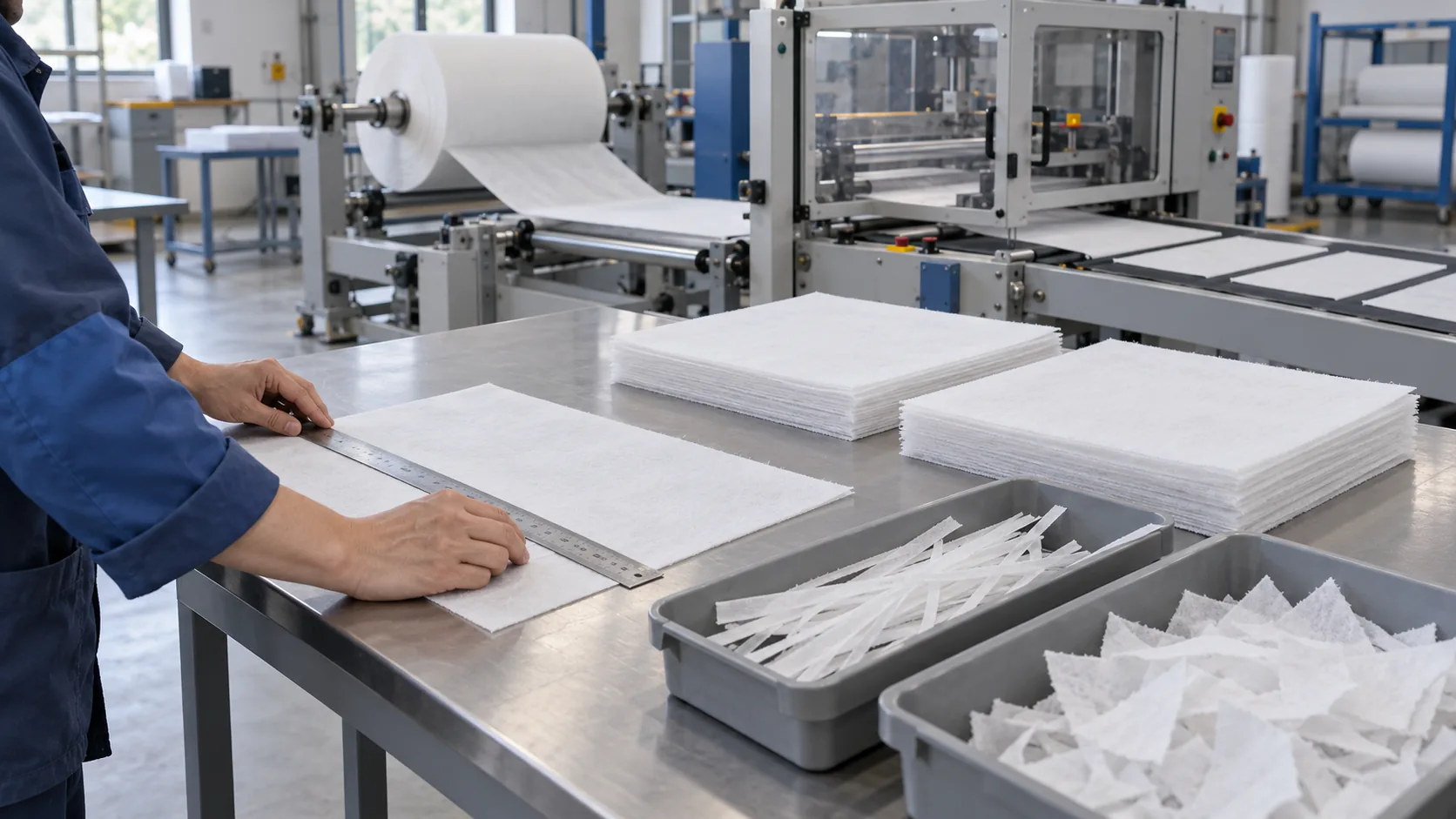
Material waste is a common concern in fabric converting and nonwoven processing. Even small cutting errors can create unnecessary scrap when repeated across hundreds of pieces.
For factories working with roll materials, waste does not come from the cutting blade alone. Roll alignment, material feeding, strip width planning, and incorrect machine settings can all affect the final result.
The following six checks can help manufacturers identify avoidable waste and improve material utilization.
1. Identify Where Cutting Waste Occurs
Before changing machine settings, determine where material is being lost.
Common sources include:
- Edge trim: Material removed from the sides of a roll.
- Setup scrap: Pieces discarded during machine adjustment.
- Incorrect dimensions: Finished pieces outside the required tolerance.
- Material damage: Wrinkles, stretching, pressure marks, or damaged edges.
- End-of-roll waste: Material remaining after an order is completed.
Record each type separately. This makes it easier to distinguish unavoidable trim from waste caused by an incorrect setup.
For example, if most rejected pieces have inconsistent lengths, investigate material feeding before changing the slitting arrangement.
2. Plan Strip Widths Before Production
When a wide fabric roll is divided into narrower strips, the cutting layout directly affects material utilization.
Consider a simplified example:
A factory has a roll with a usable width of 1,000 mm.
It needs four strips, each 230 mm wide.
The required combined strip width is:
4 × 230 mm = 920 mm
The theoretical width utilization is:
920 ÷ 1,000 × 100 = 92%
The remaining 80 mm must accommodate edge trim, spacing, or other unused width.
This is a planning example, not a verified machine performance figure. Actual usable width and cutting allowances depend on the material, blade arrangement, and required edge quality.
Before production, confirm the roll width, finished strip widths, number of strips, and permitted tolerances.
3. Check Roll Alignment and Unwinding
Poor roll alignment can cause the material to move sideways during feeding.
This may lead to uneven strip widths, wrinkles, or additional edge trimming.
Before starting production:
- Check that the roll is positioned correctly on its holder.
- Align the material with the feeding path.
- Inspect the material guides.
- Confirm that the material unwinds smoothly.
- Run a short test at a manageable speed.
Avoid applying unnecessary tension to flexible or stretchable materials.
For nonwoven fabrics, material thickness, stiffness, and surface characteristics may influence how the roll travels through the machine.
4. Adjust Feed Roller Pressure Carefully
The feeding system controls how material enters the cutting section.
Insufficient roller pressure may allow slippage. Excessive pressure may leave marks or deform sensitive materials.
Both conditions can contribute to rejected pieces.
HESPER's Fabric & Nonwoven Slitting and Cross-Cutting Machine includes pressure-adjustable feed rollers and programmable cutting settings.
When preparing a production run, operators should check:
- Roller contact with the material.
- Material movement during feeding.
- Whether the material stretches or slips.
- Consistency between the programmed and measured cutting length.
Use the machine's operating instructions when making adjustments. Confirm the settings with actual material samples before increasing production speed.
5. Inspect the First Pieces Before Running a Full Batch
A machine may complete repeated cutting cycles while still producing pieces outside the customer's required dimensions.
That is why first-piece inspection matters.
Cut a small sample batch and measure several consecutive pieces.
Check the following:
Finished dimensions
Measure the length and width against the specified tolerances.
Cutting edges
Look for fraying, incomplete cuts, deformation, or unacceptable surface marks.
Consistency
Compare several pieces rather than relying on one measurement.
Material condition
Check whether the material remains flat and whether stretching affects the finished dimensions.
If the results are inconsistent, correct the setup before continuing.
For smaller production orders, this simple check can prevent an entire batch from being rejected.
6. Record Material Yield and Repeatable Settings
Material yield helps manufacturers understand how efficiently raw material is converted into acceptable products.
For a rectangular roll-cutting process, a simplified area-based calculation is:
Material Yield (%) = Accepted Finished Area ÷ Material Area Consumed × 100
For example, if a production batch consumes 100 m² of material and produces 91 m² of acceptable finished pieces, the calculated yield is 91%.
This example assumes consistent measurement units and clearly defined accepted output. Reusable offcuts should be recorded separately rather than automatically treated as waste.
Factories should also record:
- Material type and roll dimensions.
- Finished width and length.
- Feed and cutting settings.
- Accepted and rejected quantities.
- Reasons for rejection.
These records provide a useful starting point when similar orders return.
Choosing the Right Cutting Process
Not every roll material requires the same cutting equipment.
If production requires only fixed-length sheets, a cut-to-length machine may be sufficient.
If a wide roll must be divided into several narrow strips and then cut to length, combined slitting and cross-cutting may be more suitable.
HESPER offers different configurations for these requirements.
You can explore the HESPER Roll-to-Sheet Cutting Equipment or review the Nonwoven Cutting Guide for Small Batch Processing for additional information.
Actual material compatibility, cutting dimensions, and finished edge quality should be confirmed using production samples.
Frequently Asked Questions
What causes excessive waste in automatic fabric cutting?
Common causes include incorrect strip-width planning, unstable feeding, poor material alignment, unsuitable settings, and cutting defects.
Identifying the main source of rejected material is usually the first step toward reducing waste.
Can an automatic cutting machine eliminate material waste?
No. Some edge trim and setup waste may be unavoidable.
However, an appropriately configured machine, combined with suitable material preparation and quality checks, can help reduce preventable cutting losses.
Should manufacturers test materials before purchasing a cutting machine?
Yes. Material samples help verify feeding behavior, finished dimensions, edge quality, and equipment suitability before committing to a configuration.
Discuss Your Cutting Requirements with HESPER
Every production application has different material and finished-part requirements.
If you are planning a fabric or nonwoven cutting project, share your roll dimensions, material specifications, finished sizes, tolerances, and expected production quantities.
Visit HESPER Cutting Machinery to explore suitable equipment and discuss your application.