
Should you cut PE film into sheets before the next process, or trim it afterwards? The order can affect handling, material use and the edges of the finished part. Start with what the next operation actually needs.
This guide focuses on polyethylene film roll-to-sheet cutting: when to prepare individual sheets, when to keep a continuous roll intact, and what to check before choosing a PE film cutting machine.
Start with the next operation
Different jobs raise different questions. The examples below are decision points, not rules for every material or workshop:
- Sheet-fed work: confirm sheet dimensions, squareness and how the next operation holds or feeds each sheet.
- Continuous roll-fed work: confirm where sheet separation belongs in the printing or laminating process before pre-cutting.
- PE protective film: identify adhesive and liner layers, and specify whether the cut must pass through all layers.
- Final trimming: allow for handling and alignment, and assess the complete bonded or laminated structure before selecting a cutting method.
Choose the cutting order around the process
| Situation | Option to assess | Why |
|---|---|---|
| Next operation needs separate flat sheets | Consider pre-cutting | Check the finished sheet size, handling and feeding requirements. |
| Layers will be bonded and need aligned final edges | Consider trimming after bonding | Allow for movement and trimming; confirm the bonded material and adhesive can be cut with the chosen method. |
| Small or difficult-to-hold pieces | Plan support before selecting the order | A fixture or a larger blank may make handling easier; assess the actual job. |
| Many equal-length pieces from a roll | Consider automatic cut-to-length processing | It can reduce repeated manual length setting, but usable output and accuracy need a sample trial. |
| Next operation takes continuous roll stock | Keep the roll intact until the required cutting stage | Pre-cutting would interrupt the continuous feed; confirm where sheet separation belongs. |
Use this as a starting point. The right order is confirmed with your own material and process.
When to pre-cut PE film rolls into sheets
PE film often arrives on a roll. If your next operation needs individual sheets of a fixed length, consider pre-cutting. A roll to sheet cutting machine feeds the film from the roll and cuts across its width at a preset length.
Pre-cutting is not automatically the right choice for a roll-fed printing or laminating line. If cutting printed film to a mark is required, provide the print repeat and registration tolerance. Adjustable length alone does not establish print-registration capability.
If PE film is bonded or laminated to another material first, the complete structure becomes the material you cut. Provide every layer, total thickness and any adhesive or liner for assessment; a PE layer alone does not establish suitability.
PE means polyethylene. LDPE, HDPE and PE protective film applications each need an exact film specification and a representative sample; the material name alone does not establish suitability.
HESPER 300 mm PE film roll-to-sheet cutting machine
The HESPER 300 mm PE film roll-to-sheet cutting machine feeds film to a preset length and cross-cuts it into sheets. Click the reference photo to open the PE product page. The photo identifies the equipment; it is not proof of the material grade shown or a cutting trial for your film.
Product details: PE film cutting machine
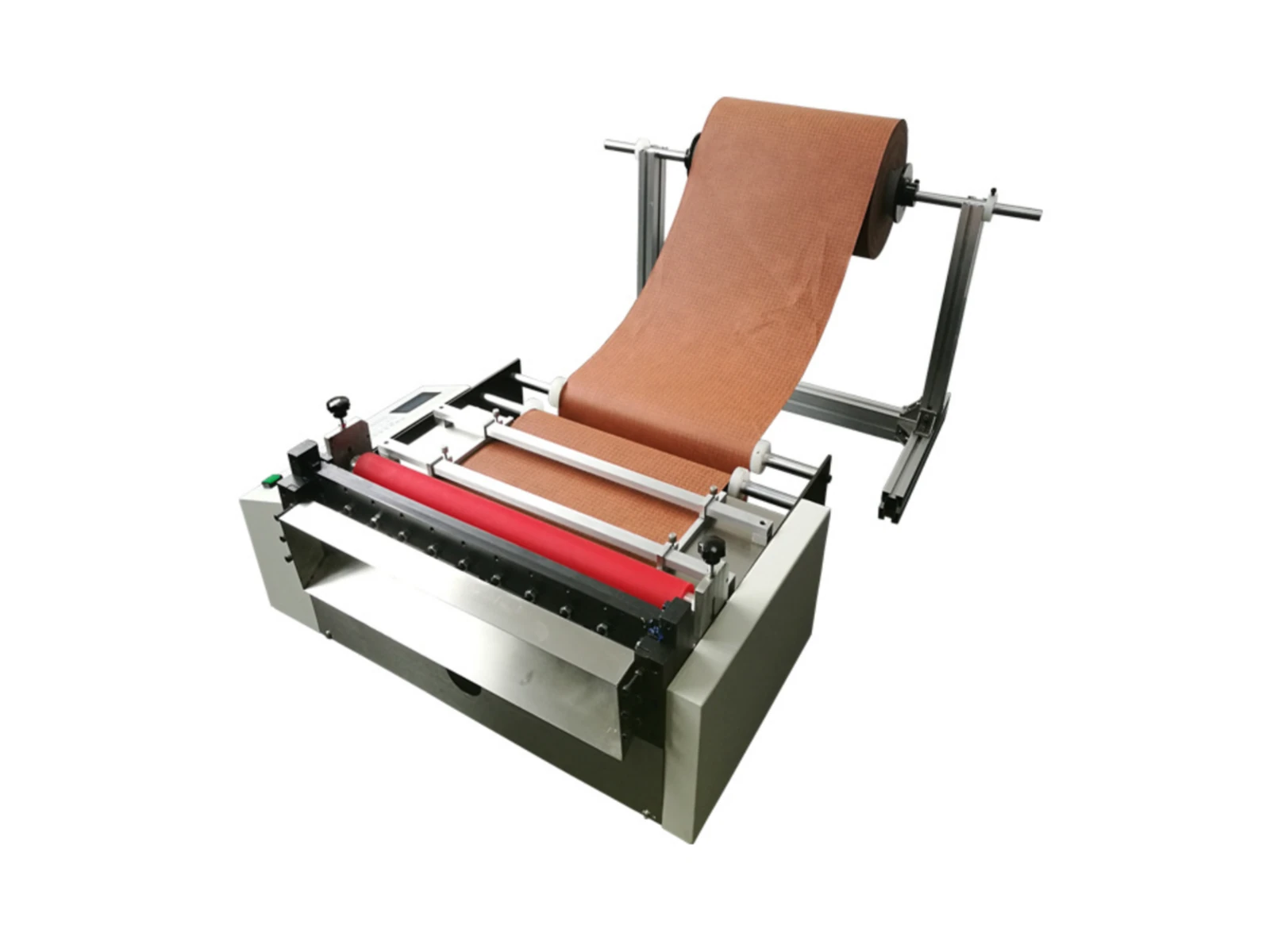 300 mm PE Film Roll-to-Sheet Cutting Machine
Equipment reference photo: HESPER, from the linked PE product page. Shown material is not proof of film grade or cutting performance.
The PE product page lists the catalogue values below. Select a plastic film cutter by the actual film structure, feeding conditions and required result; the usable range, tolerance and output depend on the PE film and configuration.
| Specification | PE film cutting machine |
|---|---|
| Catalogue-listed cutting width | 0.1–300 mm (0.1 mm is not a verified minimum slitting width) |
| Catalogue-listed cutting length | 0.5–99,999.9 mm |
| Catalogue-listed cutting speed | 34 m/min |
| Feed and cutting drive | Stepper motor feed; 120 W AC geared cutting motor |
| Controls | LCD and keypad, switchable Chinese / English |
| Weight / size | 60 kg; 580 × 600 × 400 mm |
| Optional | Longitudinal blades for slitting and cross-cutting |
The 34 m/min figure is a catalogue-listed linear cutting speed, not sheets per minute or guaranteed good-sheet output. Sheet length, cycle timing, loading and stops affect finished output. The control panel’s 0–80 scale is a setting range, not metres per minute. Optional slitting prepares cut pieces; the described process does not include rewinding, heat sealing or bag making.
Watch the machine feed and cut
The PE product page links to this English equipment demonstration. It shows the machine arrangement and operation; it does not validate every PE film grade, coating or laminate.
Open the demonstration on YouTube ↗
What decides PE film sheet quality
PE film grade, thickness, stretch, surface friction, coatings and winding condition affect feeding and finished-sheet quality. A sample trial should confirm:
- Length consistency across many sheets, not just the first one
- Edge quality of the cut
- Roller marks or scratches on the film surface
- Squareness and stacking, if the sheets go to another machine next
For PE protective film, the PE page also asks you to identify any adhesive layer or release liner and to say whether the cut must pass through all layers. For more on film testing, see our guide to testing scratches, skew and length variation on film rolls, and our explanation of slitting and cross-cutting.
What to send for a PE film cutting trial
- PE film grade (such as LDPE or HDPE) and full structure, including any coating, adhesive or liner
- Film thickness and any surface treatment or coating
- Roll width, outer diameter, core size and roll weight
- Sheet length and width, and the tolerance you need
- If slitting: strip widths and number of strips
- For protective film: adhesive layer, liner and whether all layers are cut
- Target output, and the voltage and frequency at your site
- A representative film sample
Frequently asked questions
Should PE film be cut into sheets before or after the next process?
Consider cutting first when the next operation needs individual sheets of a specified size. Consider trimming after bonding when the assembled layers need aligned edges and the cutting method is suitable. Keep continuous roll stock intact when the next operation requires it. Confirm allowances, handling and cutting order with the actual process.
What are the listed cutting ranges for the HESPER PE film cutting machine?
The PE product page lists a cutting width of 0.1–300 mm, cutting length of 0.5–99,999.9 mm and linear cutting speed of 34 m/min. The 0.1 mm value is not a verified minimum slitting width, and 34 m/min is not sheets per minute. Confirm the practical processing range, tolerance and output with your PE film and configuration.
Can this machine slit PE film into strips as well as cut sheets?
Optional longitudinal blades can combine slitting with cross-cutting. Provide the incoming PE film roll width, strip widths, number of strips and finished lengths. Rewinding slit film into new rolls is not part of the process described on the PE product page.
What should I specify for PE protective film with a liner?
Identify the adhesive layer, liner and full layer structure. Specify whether every layer must be cut through or whether the backing must remain intact. Send a representative sample and cut requirements so the configuration and cutting method can be assessed.
Deciding when to cut your PE film? Send HESPER your film type, roll size, sheet dimensions and a sample. We will review the cutting order with you and suggest the configuration to test. Send an enquiry or email sales@hespermachine.com.