
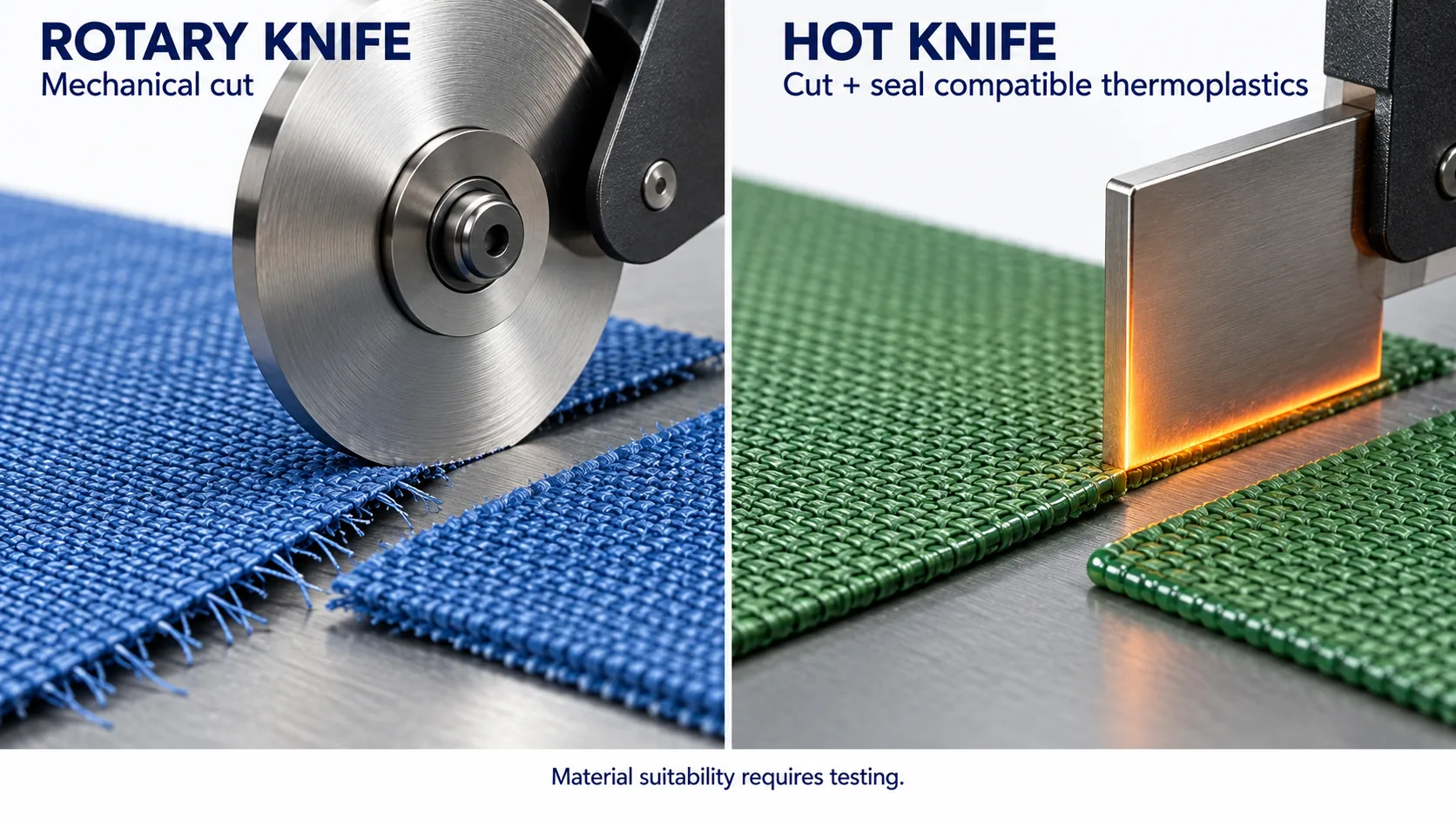
Rotary knife cutting and hot knife cutting solve different production problems. A rotary knife cuts mechanically with a rotating blade. A hot knife uses heat to cut, and can also seal the edge of suitable thermoplastic materials. The better choice depends on the material, the finished edge and the cutting operation—not simply on which machine runs faster.
For workshops processing fabric, webbing or roll materials, start with an actual sample and a clear finished-part specification. Two materials that look similar may behave differently when cut.
How does rotary knife cutting work?
A rotary knife has a circular cutting edge that rotates as it cuts. Handheld round knives are commonly used for straight lines and broad curves. In roll processing, rotary slitter assemblies divide a wider web into narrower strips. These are different arrangements, so specify the operation you need before discussing a machine.
This mechanical method is worth evaluating when you want to avoid deliberate heating and a cut edge without thermal sealing is acceptable. Depending on the blade and machine, it can be considered for textiles and other flexible materials. Thickness, number of layers and material support must match the equipment.
The edge remains mechanically cut: woven materials may still fray and require finishing. A dull blade, unsuitable support or poor feeding can affect the cut. Rotary knife cutting should not be treated as a guarantee of a clean edge on every material.
How does hot knife cutting work?
A hot knife heats the cutting blade. On compatible thermoplastic fabric or webbing, the heat melts material at the cut, allowing adjacent fibres to fuse along the edge. This can combine cutting and edge sealing in one operation.
Consider this process for suitable synthetic tapes or webbing when controlling fraying matters. Confirm the composition rather than relying on labels such as “fabric” or “nonwoven.” Cotton, paper, mixed fibres, coatings and laminated structures should not be assumed to seal like a fully thermoplastic material.
The trade-off is thermal influence on the edge. Inspect samples for discolouration, shrinkage, distortion and an excessively hard or raised edge. Temperature and contact time must suit the material and the desired finish. Follow the equipment instructions for ventilation, guarding and handling the heated blade.
Rotary knife vs hot knife: a practical comparison
| Selection point | Rotary knife | Hot knife |
|---|---|---|
| Cutting principle | Rotating blade cuts mechanically | Heated blade cuts suitable material |
| Edge sealing | No deliberate thermal sealing | Possible on compatible thermoplastics |
| Main checks | Blade condition, support and fraying | Temperature, contact time and heat effects |
| Material selection | Match blade and machine to the material | Confirm composition and thermal suitability |
| Finishing needs | May require a separate edge treatment | Check whether the sealed edge meets requirements |
Cold cutting is a broader category than rotary knife cutting: a cold cutter may use another blade mechanism. Likewise, a machine offering hot and cold modes does not automatically include a rotary knife.
Choose around the material and the finished part
If a sealed edge is required on compatible thermoplastic webbing, evaluate hot cutting first. If the material or its coating is sensitive to heat, evaluate a mechanical cutting process and confirm any additional edge finishing. For mixed materials, test each construction separately.
Also distinguish slitting from cross-cutting. Slitting determines strip width along the roll; cross-cutting produces the required length. A project may need both operations, but the blade arrangement for one does not establish capability for the other.
For repeated tape lengths, review HESPER’s hot and cold tape cutting machine as one cut-to-length option. Confirm the actual cutting mechanism, material compatibility and configuration before choosing it.
Compare the complete production cost
Compare usable parts rather than advertised maximum speed. Include loading, setup, inspection, blade maintenance, rejected pieces and any separate edge-finishing step. For hot cutting, include warm-up and the ventilation required by the process. For mechanical cutting, include the time needed to manage fraying where relevant.
A faster cutting cycle is only useful if the parts meet the specification. Frequent material changes and short batches can make setup time particularly important.
What should a sample cutting trial check?
- Dimensions: check finished width and length against the stated tolerance.
- Edge quality: inspect loose threads, deformation, colour changes and the feel of a sealed edge.
- Repeatability: compare samples throughout the trial, using agreed acceptance criteria.
- Next process: confirm that the cut edge suits sewing, bonding, assembly or other intended finishing.
Send HESPER your cutting requirements, including material composition, width, thickness, finished dimensions, tolerance, edge requirements and target output. Use the roll-material enquiry checklist to prepare a clear brief. A sample trial is the practical way to choose a cutting method around your product.
Technical background: Eastman round knives and HSGM heat-cutting principles.