
When photoluminescent film is cut into short pieces, the first cut is rarely the whole challenge. The harder question is how to keep lengths consistent as order quantities grow. For parts that need decimal lengths and large batches, length settings, feeding arrangements and accepted output need to be considered together—not simply the fastest cutting rate.
A European measuring-tool manufacturer brought us a request for pieces from 13.5 to 15 mm long, with a length tolerance of ±0.25 mm. Daily demand was 100,000 pieces, alongside smaller orders of 10,000. The customer reported that their existing equipment took about two and a half hours to cut 10,000 pieces. At the same processing rate, 100,000 pieces would take around 25 hours. That gap shaped the inquiry: how could decimal lengths be produced consistently, and could side-by-side rolls increase the number of pieces per stroke?
Entering 13.5 mm is not the same as holding the finished tolerance
During the discussion, the customer asked whether lengths such as 13.5 and 14.5 mm could be entered directly on the control panel. Our engineering team confirmed decimal-length entry for the proposed solution, without rounding the target to a whole number. This makes size changes more straightforward when orders use several lengths.
A setting and a finished dimension are different things, however. The requested ±0.25 mm needs to be checked on the cut parts. A trial should examine the first pieces and whether lengths remain consistent during continued running. If several rolls are fed together, each lane needs checking. That shows whether the setting holds across a batch rather than only on a few initial samples.
Plain and adhesive-backed film need separate trials
The request covered photoluminescent film supplied in narrow rolls, in plain and self-adhesive versions. The plain material was 0.68 mm thick in widths of 37, 39 and 46 mm. The self-adhesive version was 39 mm wide and 1.00 mm thick overall, with double-sided adhesive tape laminated to its back. Roll outside diameters were about 220 mm, or 195 mm for the adhesive version, with a 75 mm core inside diameter. Both were to become straight-cut rectangular pieces, without holes or shaped ends.
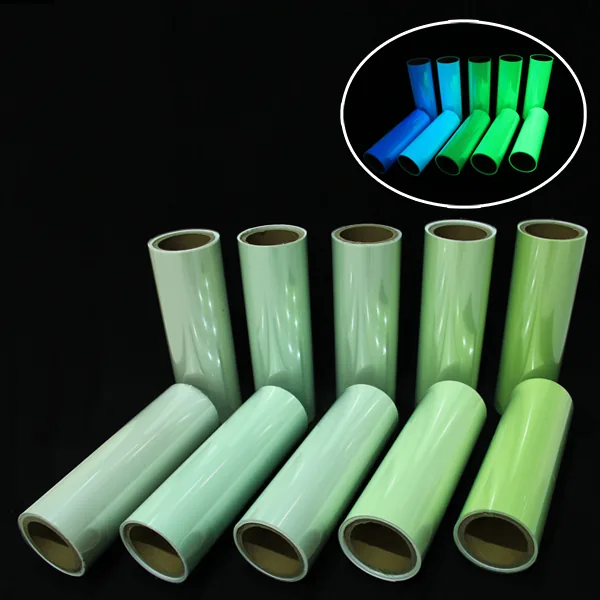
A cold blade cut was therefore the approach discussed. For the self-adhesive photoluminescent tape strips, length is only part of the trial: the pieces should separate fully, the backing should stay attached, and the blade needs checking for adhesive buildup during continued cutting. These details affect assembly and sustained operation. A neat-looking first piece does not settle the process for an entire batch.
Side-by-side rolls need space for more than the material itself
Short-piece production offers another route to assess alongside faster single-roll feeding: several rolls feeding side by side for a common cutting stroke. With four lanes feeding correctly and each producing one piece, a stroke yields four pieces. The practical questions are whether all lanes feed consistently and how many of those pieces meet the required dimensions.
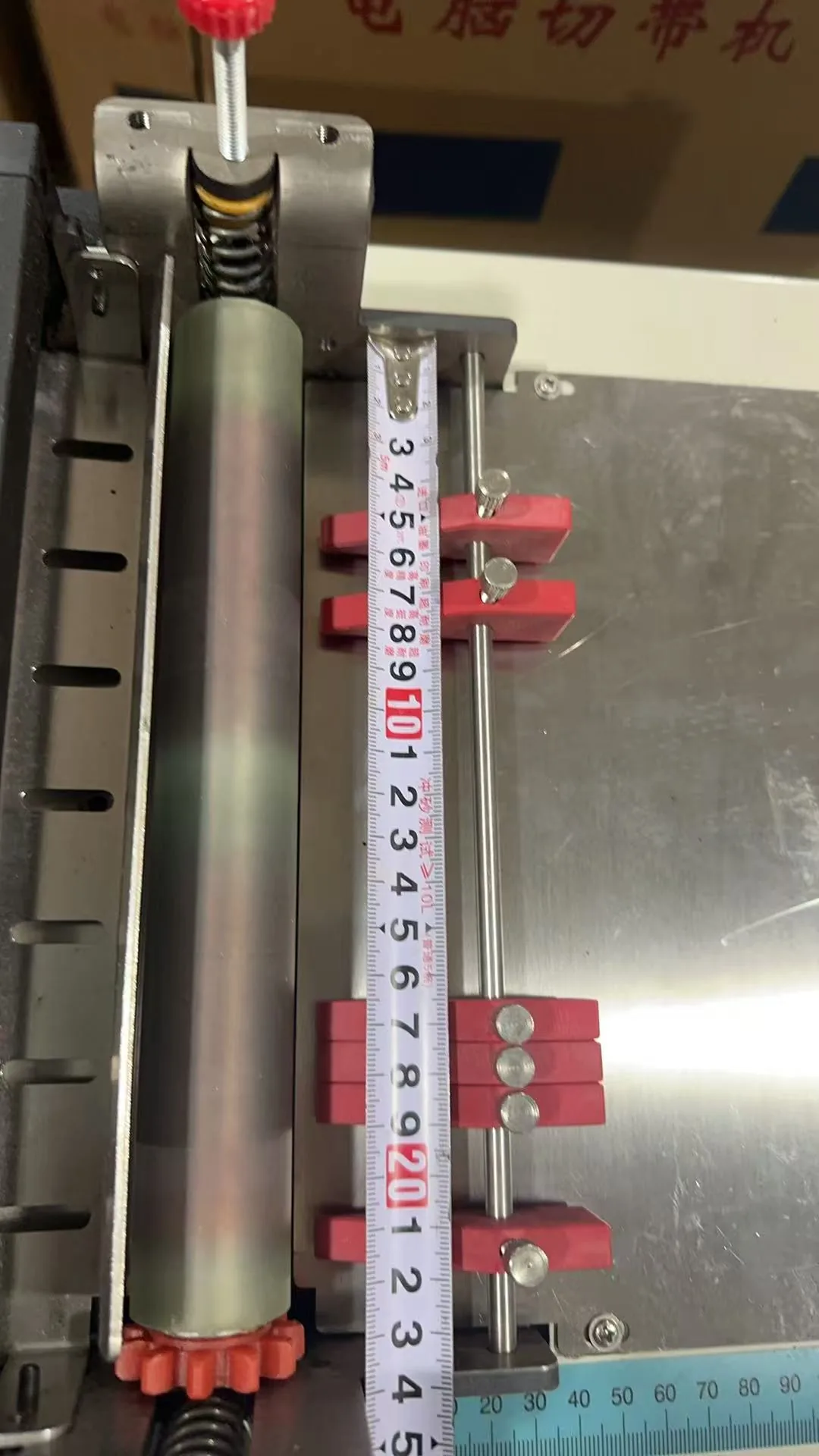
Working width therefore becomes part of the selection. Four 46 mm rolls occupy 184 mm before guides and gaps. The 320 model lists a cutting-width range of 1–310 mm. Using 310 mm gives a difference of 126 mm for assessing lane spacing and guide requirements; the actual arrangement still depends on the machine structure. It uses a stepper motor and allows cutting length, speed and quantity to be set. Its stated 110 pieces per minute uses a 50 mm cut length as the example. For 13.5–15 mm photoluminescent film pieces, working speed should be established with actual feeding, dimensions across all lanes and collection considered together.
The value of multiple lanes has to be judged over a complete batch. Roll changes, collection, blade cleaning and dimensional checks all take time. A lane that drifts or stops feeding can also affect accepted output. Rather than multiply pieces per stroke into a daily-output claim, record these parts of the trial and compare the resulting working rate with the customer’s requirement.
Use the actual material to turn the proposal into something measurable
For this inquiry, we suggested about five meters of each specification. Trials would start with target lengths such as 13.5 and 14.5 mm, then compare the plain and adhesive-backed versions. If side-by-side feeding is being considered, the lanes also need checking together rather than relying on a single-roll result.
Batch handling matters for both 10,000-piece orders and higher daily demand. Selection should include a discussion of batch counting, whether pauses between batches are needed, and how the pieces will be collected for checking and removal. With multiple lanes, confirm whether the counter records cutting strokes or actual pieces, so the display is not mistaken for the delivery quantity. Samples help assess cut quality and dimensions; meeting daily demand also requires an assessment of available working hours, roll changes and sustained running.
If you need to cut photoluminescent film or tape into short pieces, send HESPER the target lengths and tolerance, material width and thickness, whether it is adhesive-backed, and your daily quantity and available working hours. Add photographs of the rolls and finished parts. The discussion can then start with your parts and work towards a suitable feeding, cutting and collection arrangement.
Discuss short-piece cutting with HESPER
Send your cutting requirements · sales@hespermachine.com
For machine structure and features, see the fully automatic hot and cold tape cutting machine, then discuss feeding and cutting arrangements for your photoluminescent film.