
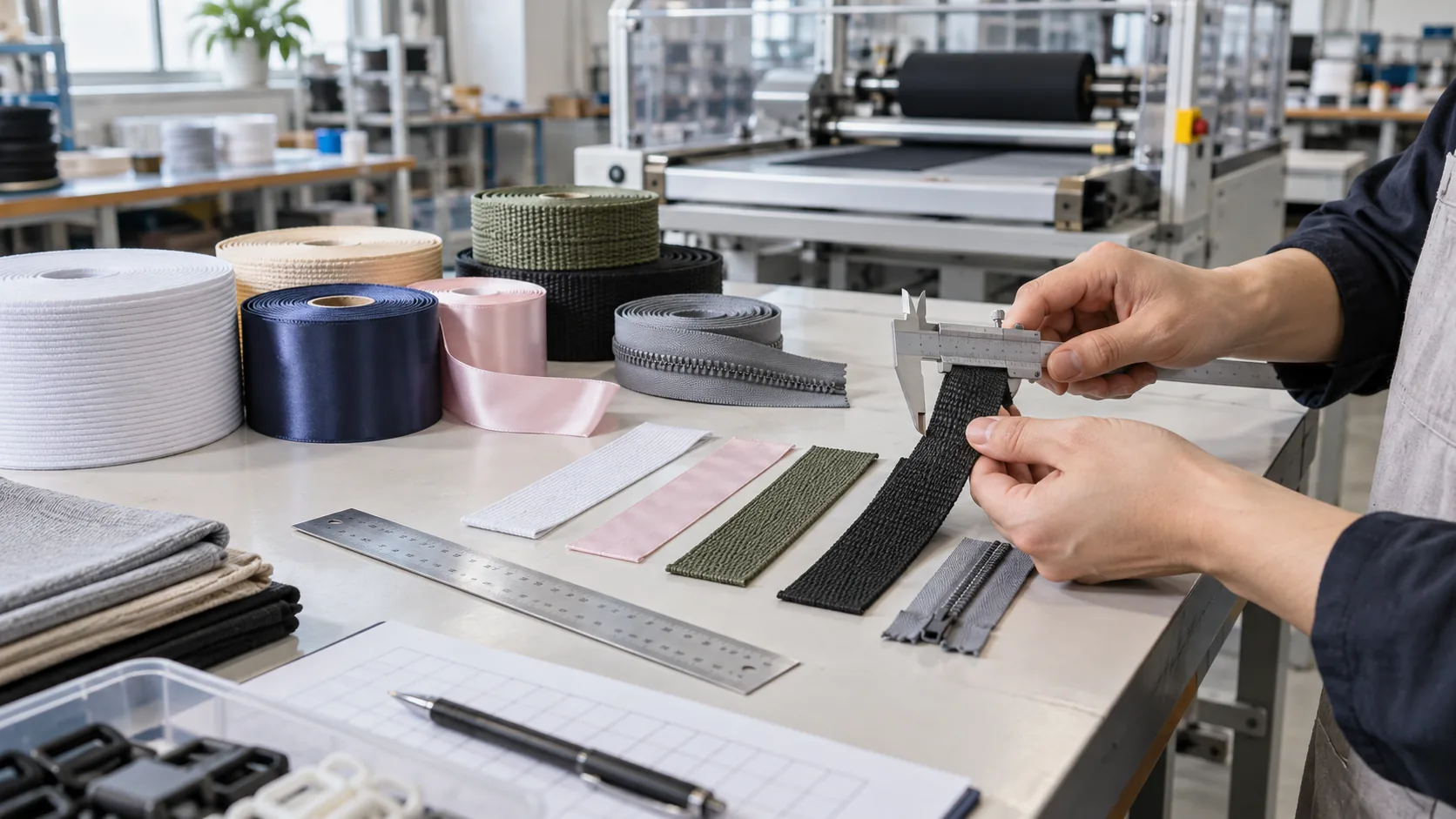
Choosing a roll material cutting machine for garment accessories starts with the material and the finished part. Elastic bands, ribbon, webbing and zipper tape may all arrive on rolls, but they do not necessarily need the same feeding system or cutting method.
Before comparing machines, define the dimensions, edge finish and batch quantities your workshop needs. A useful trial should show how the equipment handles your material through a complete batch, including setup and inspection.
1. Define the material and roll size
Give the supplier more than a general description such as “fabric tape.” Specify the composition, width, thickness and any coating or adhesive backing. Explain whether the material stretches, slips easily or must remain free of pressure marks.
Include roll outside diameter, core inside diameter and roll weight. These affect the choice of roll holder and unwinding arrangement. A machine that accepts the strip width still needs a suitable way to support and feed the full roll.
2. Specify the cut you need
For simple cut-to-length work, provide the shortest, usual and longest piece lengths, together with the permitted tolerance. If you also need longitudinal slitting, angled ends, holes or cuts aligned to printed marks, state this separately. These requirements can call for different equipment or additional functions.
For garment accessories that will be sewn or assembled, explain which dimensions matter at the next operation. Include a drawing or an approved sample where possible, rather than relying on a photograph alone.
3. Match the cutting method to the edge finish
Discuss cold cutting, hot cutting or ultrasonic cutting against the actual material and the required edge. Ask the supplier to demonstrate the proposed process on your samples. Check for fraying, unwanted stiffness, discoloration, deformation and changes to the surface or coating.
Do not assume that one setting works for every ribbon or elastic band. For an initial equipment comparison, see the HESPER hot and cold tape cutting machine. Its suitability and cutting mode should be confirmed using your material and acceptance criteria.
4. Check feeding and length consistency
Cutting accuracy depends on how the material reaches the blade, as well as the cutting mechanism. Ask how the guides, feed rollers and roll supply are adjusted for your material. Look for sideways movement, slipping, excessive tension and visible roller marks during a trial.
For elastic tape, agree on the condition in which finished pieces will be measured, including whether they should be relaxed before inspection. Compare a series of pieces throughout the batch; a single correct sample does not establish repeatability.
5. Compare practical output and changeovers
For small batch production, setup and changeover time may matter as much as cutting speed. Time the full job: loading the roll, adjusting settings, approving the first piece, running the batch and collecting acceptable parts.
Compare output at your usual cut length and material, rather than relying on a maximum cycle rate. Also confirm the available power, any compressed-air requirement, floor space, operator access, cleaning needs and replacement-blade arrangements for the proposed configuration.
Start with a clear sample brief
Before ordering, send a material sample, roll dimensions, finished-part drawing, tolerance, edge requirements and typical batch quantity. Agree on how the trial results will be checked and which settings or configuration the quotation covers.
The right garment accessories cutting machine is the one that fits your recurring work and produces acceptable parts under agreed conditions. Send your roll material cutting requirements to HESPER to discuss a suitable configuration.